Friday, 20 May 2011

Wanted, Dead or Alive

There's a reality that exists where you are alive.  That's the reality that you currently inhabit, I hope.

There are also realities that exist when you do not exist.  That reality was in the past, but it will also come to be again in the future. The one where you are unborn or deceased.

Both realities are equally valid.  They just occur at different times.

Time is a dimension of the universe.  Beyond height, width and depth it's the most obvious 4th dimension.  (Physicists by the way talk about 10 dimensions in our observable universe. I can't get my head around that, but apparently it makes sense mathematically).

A 4 dimensional cube

Everything is relative.  For example, distance is relative to the person observing it.  I just moved 2cm to my right in my train seat. To the person standing on the train platform I just moved 10 metres in the same time.

Just as distance is relative to the person observing it, so is time. You are alive because you are the one observing yourself.  You cannot observe yourself dead.  But the reality of your non-being already exists, it's just that your position in time relative to it does not allow you to observe it.

If that's the case - I am already dead. I am alive and dead at the same time, just in different realities.  Fortunately I experience the reality where I am alive, not dead - and I appreciate that.

This is a strange realisation.  But strangely liberating.

Once you see life in pure relative terms with no absolutes, it starts to make more sense. You really appreciate the moment.  You wake up each day with a zest to live and enjoy the moment.  In the history of the universe, it is almost nothing.  But we know it's not nothing, it's everything.

Live life knowing you're already dead.  Try it.

Thursday, 19 May 2011

How To Be Number One In Google

At last!  After 10 years of trying, I can now say I am number one in Google.

No, I am not some boiler-room SEO sales guy.   Yes, I do have an ego.

Search for "David Norris" and you get me as number one.  Well, you do if you are me, today, from the UK.  Who knows if this is a Google A/B test.


Joking aside, this is a clear sign that Google are taking on Facebook and building a social strategy.  What better incentive to get people to complete their Google profiles than to provoke their ego.  "Want to be number one in Google for your name search?  Get your profile up to date".

I noticed this because I was checking Google Analytics for the traffic to my Google blog (Blogger) and saw a spike in traffic yesterday.  I looked at the source and keywords used and saw a large number of searches for my name delivering traffic.

I did the name search and saw the screenshot above with my name number one with my Google profile with an "edit" button. (Of course! Because I have a Gmail account).   As I use Picasa and Google Contacts, my profile is starting to become very integrated.

It's clear, Google are in battle.  Let the games commence!

Monday, 2 May 2011

Why Your Weaknesses are Your Strengths

My grandma once told me a story about how my younger self was prone to impulsive urges.
We were walking past a shop and in the window was a toy car. I really wanted that toy car and started pleading with my grandma to buy it.

She asked me how much pocket money I had and whatever I had was not enough. She said that we could come back on the weekend when I would have received some pocket money and have had a chance to save up for it.

I was not happy. I did not want to wait until the weekend. I can't imagine it was a pleasant scene. Still, my Grandma (rightly so) stood firm and we did not buy the car. Not then and not at the weekend because by then I was no longer interested in the car.

She told me this story about my younger self when I was a teenager. She said she was worried about my impulsive nature. It's true, I do have an impulsive nature. And I love it. I've learnt to control spending urges, but there have been many times in life when this side of my character has served me well. I've done many unusual things in life that have left a richness of experience and that in part is due to my willingness to make instant decisions and "do".

Impulsiveness can be a weakness, it can also be a strength. The same is true I find of most personality traits. It all depends on context. Most traits have a use so if you can understand better who you are and put yourself into situations that suit your personality, you'll find a good path.

Very persuasive, tenacious and curious? Great if you are an investigative journalist or sales person. Not very good at writing? Perhaps sales works better for you than journalism.

I don't actually believe that we have "strengths" or "weaknesses". I believe instead that we all have certain personality traits that are amplified, that we use and abuse and that in the right context can be a strength.

Therefore if you are interviewing for a job, either as a candidate or as a recruiter, consider it a dating game. You're both trying to assess if this person is the right "fit" for the job. The right person for the job may well be narcissistic, impetuous and driven by self-doubt. Or gregarious, conservative and self-confident. Or not. It's all about the fit at that moment in time.

There are no strengths and weaknesses, only context.

Thursday, 28 April 2011

When Is Too Much Cheese Fondue Too Much?

Is there a limit to how much cheese fondue we can handle?

Yes, and it's about 50 servings.

Huh?

Maybe I'm not making sense so I'd better explain myself.

Back in 1990 a young David Norris left university in the midst if a recession with limited career options. (Theology as a degree isn't exactly vocational unless you want to be a priest - and as an atheist I wasn't sure I could be convincing at interview). So, at the relatively young age of 21 I decided I still had time on my side and could do worse than follow my passion.

With student debt to forget, I took the train to Dover in early December, the ferry to Calais and a train to Paris. I muscled through the metro system in rush hour to get a night train south. I woke up in Bourg St Maurice in the French Alps with about £100 to my name and I took a bus to Val D'Isere with my backpack, ski boots, skis and a burning desire to find a way to stay there and ski for 5 months. Nothing else mattered.

I had the advantage of speaking some French. So I knocked on doors for 3 weeks asking for work. I found a place to stay during thus time, sharing an apartment for 3 with 10 other ski bum hopefuls. (Yes, it was smelly, messy and wild). I made friends and it was through a friend that I heard about a job in a restaurant kitchen. Lesson 1: networks bring opportunities.

As my credit card was maxing out I managed to persuade this restaurant to take me on. I was to be a "plongeur". And this is where the cheese fondue comes in. A plongeur is a kitchen assistant and wash up. They didn't know it when they hired me and I didn't know it either but they had just hired the best damn plongeur in history.

I was super motivated. I was getting to ski every single day. I would wake early, be on the first lift and ski to 3 or 4. Then, shower, change, snooze and get to work for 6. Because I wanted to be out early skiing the next day I wanted to fully optimise everything possible and be ready to leave work as soon as possible. The earliest was midnight. On a busy night it might even be 2am.

Yes - that really is me

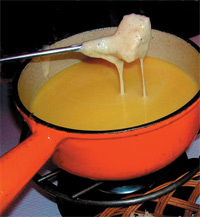
Cheese fondue is served in a ceramic pot. It's mainly melted cheese with some wine and a few other secret ingredients. Dunk dried bread into the cheese. A local speciality. Indeed our restaurant was a local speciality restaurant. We served meat fondue, cheese fondue, raclette, steak tartare (raw minced beef steak) and other high protein feasts.

There were two chefs and myself in the kitchen, a waitress, the owner and his wife. On a busy night we would turn 100+ covers. The French chefs and I kept ourselves fired up with plenty of Dead Kennedys punk classics. They knew all the words.

I was paid about £150 a month. Accommodation included. I paid £60 a month for my season-workers lift pass, then I had some pocket money for ski servicing, beers and food. Slave labour. Loved it.

My main job, apart from washing up was to prepare the desserts. I was an expert at classic ice cream creations such as Banana Split, Peche Melba and Cafe Liegois. The cheese fondues would be stacking up as I prepared the desserts because of course, it's when the main course is brought in that the desserts are then ordered. It's a double whammy because not only have you got more washing up to do you have less time to do it because you're having to prep desserts. Actually, it was really a triple whammy because on a busy night I had to also keep the flow of the crockery and pots back into service. Doing that meant less time for desserts and even less time for washing up.

At 50 fondues a night the system (me) would go into meltdown. Even though I had perfected cleaning fondue pots with a scraper, I was struggling to get the pots back to the kitchen in time and do the desserts. By midnight I had the entire restaurant stock of pots, pans and crockery stacked up in a pile. It would be a long night.

Try washing up 50 of these

I learnt a lot those 5 months that I have found useful at work ever since.  The main lesson learned though is to watch out for triple whammies. As people add more tasks or projects to the mix they sometimes forget that gives them less time to do the same jobs they already have. Also, if volumes of transactions multiply at the same time they'll have even less time to do the second job and even less time to do the first job. Meltdown is always on the horizon.

So, in a growth company, my advice would be always to think about the proposed operational solution not only in the present, but in the future as well - and in a future where you are doing twice as much business.

Triple whammies happen all the time and when they do the only solution is to dig yourself out of a hole and fix the mess. By then you've probably caused some damage and you may have lost staff, customers or suppliers. That sucks.

You need to know how many cheese fondues is too many.

Saturday, 23 April 2011

Why COOs love roundabouts

Approaching a roundabout one early morning last week, I was riding to work on my bike, crossing through Richmond Park. It was relatively quiet with a few cars and bikes and the deer were happily munching on grass in the fresh morning air.

I sailed through the roundabout without slowing down. Almost at the same time but not quite, another bike came through from another direction. And a few moments after that a car flew through. None of us slowed down, we didn't need to. It was all fluid, smooth and unintentionally synchronised.

At that time there was no need for a roundabout. We could have all managed without one. Later in the day however, with more traffic, a roundabout would become very beneficial. Someone had wisely built one.

A roundabout is both a physical technology and a social technology. Physical because it requires certain techniques and materials to build, social because it requires rules and behaviours to have benefit. We developed roundabouts to solve a volume and interaction problem.

Growing companies have the same challenges as the road traffic network. As volume and traffic builds, more processes and organisational structure (social technologies) are needed. Plus, more servers and work space are needed (physical technologies).

The CEO sets the direction. He/she says, "this the horizon we're headed towards and here's why". It's a "what" and a "why" focus. The COO however takes responsibility for how we reach that horizon, getting the right team together at the right time, building enough (but not too much process), find the best way to make the team perform together. It's a "who, when, how much" focus.

As a COO therefore I need to figure out if give way signs, roundabouts or traffic lights are needed. I need to build junctions and roads and I need to do so with a sharp eye on making sure the costs and revenues are supporting that investment.

With a tech start up, the COO role is particularly relevant. How many people to hire, in what order, how many servers to pay for, building systems for organisational effectiveness...these things are always important in any business, but in a tech start up the impact is amplified many times over. Some companies grow at 10 to 20 percent a year in revenue, people and infrastructure. For start ups, add a zero to any number. 10 times as fast. Traffic can hit your junctions pretty quickly and you need to know whether to put in place a give way sign, stop sign, roundabout, traffic lights or flyover.

That challenge of building a team and product to make possible a vision is one I love. I guess that's why I'm a COO. I love roundabouts.