Wednesday, 26 February 2014
The Dancing Guy
Friday, 1 March 2013
"If You're Going Through Hell, Don't Stop"
You start your holiday with excitement and energy. Woo-hoo! No more work for two weeks, we're off!
How long does that feeling last? When do the arguments start? Unless you're off back-packing by yourself, you'll be either with friends or family or both.
Here's typically what happens;
Day 1 - excitement, chatter, interest in other people, sharing plans, news and celebrating
Day 2 - more of the same, just a little slower but you're still all on best behaviour
Day 3 - starting to get tired, needing a little more space and time, starting to make less effort towards each other
Day 4 - the arguments start. You can no longer maintain the being on best behaviour at all times. You start to say what you really think. Others do the same. A few disagreements maybe. Maybe a full blown out row or face off
Day 5 - you start to adjust to your real travelling companions, their needs and wants, your own needs and wants, your new environment and living space, maybe a few apologies, a few honest and frank conversations
Day 6 - now you're all just being yourself and relating to others in a truthful way, you start to find ways to enjoy yourselves together on this new level
Day 7 - you're more relaxed, start to enjoy the holiday for what it really is
Day 8 onwards - you're having a great time
Does that ring a bell? Have you ever been in a holiday situation like that?
The pattern repeats itself whenever a new member joins the group or there is some kind of instability such as a change in environment. You all go back a few steps until you readjust.
The pattern has a name, you might have heard it before... Form, Storm, Norm, Perform
Form - the honeymoon period, everyone is on their best behaviour
Storm - the truth comes out, friction and strife
Norm - adjusting to the reality of the group
Perform - getting the best out of the group in a truthful way
This pattern doesn't just apply to holidays. It applies to any new collaboration of two or more people.
It applies to relationships. Remember those first 6 months? That's the form period. Some people come off that 6 month period wondering what happened. You're suddenly arguing about things you never used to argue about. Here's the truth - it's completely normal to have these arguments (storm). You need to get through them and accept the other person for who they truly are (norm) before you can be strong as a couple (perform)
It applies to companies. New people join a company and go through their own form storm norm perform before they truly settle. Some people just get out at the storm stage but others will persist and that's the route to performance.
It applies to projects. There's always a doom and gloom middle part of the project where the project manager feels like it's never going to happen. But it does.
It applies to sport. Setting out (form) on the path to glory (perform) requires a lot of soul searching and pain as you put the training in (storm and norm) to become the athlete you want to become.
In applies to studying. Learning a new skill is exciting at first (form), but you realise that it's very difficult to commit and put the hours in (storm) and until you manage to do that consistently (norm) you won't succeed (perform).
I've observed this pattern many many times in life and it's helped me enormously. When the euphoria of a new start wears off I think "hey - this is perfectly normal and to be expected - let's keep going" and it gives me strength. My expectations are more realistic and I'm less prone to reacting badly to when things go wrong. I had to learn this the hard way. Simon, my manager when I was at Eurocamp said observantly, "David, you don't like it when things go wrong, do you?" He was right of course. That's still the case, I like to get things right first time. Now I realise that is an ideal and the real world will hit me hard and I need to push through to see the success on the other side.
As Winston Churchill famously said, "If you're going through hell, don't stop"
Further reading....
Wikipedia Tuckman's stages of group development
Friday, 16 November 2012
Dr M
It was the first time that I realised that was his name. He'd bounced in and out my life over the past few years but he's never told me his name.
You see the thing is, Dr M is not a real person. He's an idea.
He's what will make your life different in the next year. And like the Holy Trinity there's three parts to his character.
D = Do
R = Read
M = Meet
These are the three things that will change your life in the next year
- what you do
- what you read
- who you meet
Do
I learn by doing. By trying things out, I develop skills, knowledge and understanding. I also put myself into new challenges, see new problems, find new solutions.
Read
Reading is nourishment for the mind. Ideas are planted, mental frameworks are thrown around, concepts are born, knowledge is gained. Ideas were born to have sex with each other. The more you read, the more ideas you have and these ideas synthesize with others to create new views of reality.
Meet
We are social animals. I find that it's by meeting with others, having conversations and doing things together that I learn new things, hear of new opportunities and (importantly) have fun.
Mix it all up
The great thing about Dr M though is when you mix it all up. Doing things, reading and then meeting up creates all sorts of new perspectives and opportunities. Reading about an idea and then trying it out. Debating ideas with others. Sharing your knowledge with others. The power is of the combinations. D+R, R+M, M+D. It's the algebra of life.
If you want good things to happen to you, remember Dr M.
Do more stuff. Read more books. Meet more people.
Wednesday, 17 October 2012
10 Ways For Teams To Do More Useful Stuff
Most managers, most of the time, have a job to do; mostly we manage a team to do stuff.
Sometimes we sit in meetings where ideas flow, sometimes we do deals. However, the nuts and bolts of business is just that; putting together nuts and bolts for other people to buy. (Or in recent years - bytes and bits).
After 20+ years of "getting stuff done" these days as a COO I'm still learning every day about what works. How to organise and coordinate teams in the most effective way. By effective, I mean in the way that creates most value for customers.
If a new manager were to approach me early in their career and ask today, "David, how can I really manage work flow well?", I'd give them the following ten tips. They are what I aspire to myself every day.
Whether it's managing software development teams, call centres, HR projects or staging events, I've found these principles to work. Until recently I hadn't been able to express them clearly. Reading about Japanese production methodologies has helped me reflect on what has worked for me and why.
So, here's my ten tips for getting stuff done well...
1. Make the work flow public
Get the work on the wall. In real time.
These days there are plenty of software solutions to track the status of a project but sadly even the best software fails when it comes to improving team effectiveness. That's because looking at a computer screen is generally not a public process and public processes create peer pressure.
Simply getting the status of the project on a wall and updating it on a daily basis creates awareness amongst all team members and prompts discussions such as, "why is everything stuck in the design phase", "we're not going to hit our target so what are we going to do" or "we're doing well". For example, use post-its that represent tasks that move along between phases of a project, columns for these phases and rows for individuals or sub-teams. Or, in the case of service environments data points such as open cases today, calls waiting, calls successfully answered within 3 rings.
By making the data public and keeping it updated the team starts to work together to address the challenge.
You might think that post-it notes, whiteboards etc are an extra layer of information processing that you don't need if you already track on a computer. Even if there is an extra cost or maintaining real time public work boards I've found the productivity gains to be worth the extra effort. It's counter-intuitive but like most things counter-intuitive it has a surprising effect.
Visual controls. They're very very effective.
2. Go and see the work
You can run all the metrics you like but a good manager needs to be close to the work.
As a Senior Manager this is not practical to do with all the teams that you manage but you still need to periodically "go and see". And literally spend time watching. It's these observations (supported by relevant data) that allow you to make the smart decisions. What's important to fix right now. What's causing the delay / error / problem. Who can help me improve this situation.
A manager is focused on what's closest to him or her. So go to where your customers are and you'll end up focusing on your customers.
3. Be your own customer
I use the word customer in the very broadest sense. Customer can mean consumer, the purchaser of the product or service. Or - a customer could be a supplier. Or - a customer could be a colleague in another team. Basically, if you deliver a service or product to anyone internally or externally, they are your customer.
For example, the finance team are customers of the HR team because they require payroll data from the HR team. The worker getting paid at the end of the month is the customer of the finance team.
Being your own customer can really expose you to the experience of being that customer. What problem is it that you need solved? What does it feel like to have that problem solved by your company? What could be better and why?
At the end of the day, people pay for products and services to solve a problem that they have. E.g. making phone calls (telephone), keeping on touch with friends (social network), self-esteem (fashion), hunger (food), family time (holiday).
If you don't experience the problem and solution yourself you cannot achieve the same level of understanding. Go and be your own customer as a customer would experience it. That helps you to see the value and see the improvements needed.
4. Be able to do the work yourself
Simply sitting with a team creates an awareness that you can't get by sitting in an office next door. Even better, you need to have done the work to truly appreciate what could be improved.
If you can shadow a team member for a day or two, see what it's like to receive the information that they receive, use the tools they use, you are so much more aware of what's important, possible or needed.
Some of the very best managers are those that worked their way up through the organisation from knowing the work in detail from the ground up. They are indeed "grounded" yet have managed to take on senior manager roles. This gives them the ability to have a "helicopter view" and a "ground level view" and they can switch between the two quickly and at will.
This is why it's so important to develop people within a team and train the next generation of leaders from within if at all possible.
5. Reduce work in progress
This is one of the most important and effective principles of all and it's one of the most difficult to achieve. Often we will hear of the importance of focus. Focus is all about deciding what not to do rather than about what to do. It actually about reducing work in progress.
If you have 10 tasks that you are simultaneously working on, you will be switching between tasks a lot. If you have 2 or 3 you can generally work through those in some detail and do them properly. You will actually end up doing more and doing it better. Fact, trust me.
Easy to say, not easy to do. Why?
Think about email as an example. You have a number of projects on the go. You reply to emails, you send emails and that's often because you're collaborating with others to achieve a project goal. Rarely do we work completely alone. The emails that are "sent" go out into the world and one day they might come back with the information you need and you can carry on. In the meantime what do we do? Go to meetings and collect new "to do" actions, plus we reply to whatever is in our inbox. This creates more threads and open items. Everyone else you're working with is doing the same thing and before long the organisation is multi-tasking and task switching adding more and more tasks that get slower and sometimes don't finish at all.
To combat this, discipline is needed. One way to achieve this is to periodically meet as a work group (daily or weekly depending on the group) and identify the top 3 things that matter for the common period and work together on those first every day until they're done. Not 10 things but 3 things.
Work through those 3 things and (here's the important bit), do not start anything new unless you've finished what you can on those 3 things.
You can always create a "queue" to have agreed items next in line once you have spare capacity to "pull" new work onto your schedule.
If you force a limit on the number of items in progress at any one time, the ones in progress move faster and the overall speed of the team improves.
I've found a useful online tool for organising projects and limiting work in progress for this purpose is Kanbanery.
6. Document the process
By writing down your process you have a point from which to measure and optimise it. In fact I would argue that the main purpose of documenting a process is so that you can change it in the future.
The process of documentation (whether it be in words or diagrams) exposes the process to the eyes of the team. You can start to see opportunities to optimise it. Do we really need to do that bit? If we bypassed step 4 would it speed up the process? How many people are involved and could we reduce that? (See point 10).
Go back to the process on a regular basis and ask, "how can we make this process better for our customers?"
Once a team understand that a process is there to be changed and not to be blindly followed without critiquing, it can be very empowering.
7. Measure the flow
How long does it take for a task to go from initiation to completion? Measuring the speed of work but also the variance of work demand is essential to speed up and smooth out the flow. And speeding up and smoothing out the flow (see point 9) leads to better value for all involved.
An example for an HR team; from job requisition approved to offer made, what is our average lead-in time? (And following on from that, what causes the delay in the process and how do we improve that without reducing quality of hires?). If you can measure the flow you can improve it. So go figure out how to measure.
8. Design processes starting with the customer
In any system, there is some kind of end result. Software shipped. Employee hired. Customer enquiry answered. Expenses paid.
When designing processes start with the end customer (either internal or external customer) and figure who sits directly before them in the process. Then who sits before them. And so on. The end customer is "downstream" and the initiator of the process is "upstream".
The process needs to be designed so that the downstream people get what they need when they need it. Then work backwards. This is known as a "pull system". A true pull system provides the quickest path to providing value for the customer.
So many organisations and teams work the other way around. They push things through and you end up with bottlenecks, delays and stress.
This a really tricky principle to pull off well and it requires the buy in of decision makers involved to make it happen. I can't claim to have mastered this myself in all areas of my work. I have however seen it work very well in software development teams that I've managed.
9. Level the flow
What does levelling the flow mean?
In software it means a steady stream of (pulled) productive work without overloading the team with spikes of (pushed) deadlines.
In contact centres it means predicting inbound consumer demand and matching staffing schedules to meet those predicted demands rather than being quite on slow days/hours and overwhelmed on busy days.
Sometimes you'll pull ahead of demand, sometime you'll catch up but all the while your people are steadily adding value in a productive way.
10. Reduce the number of people involved in a task
If a task has 2 people involved and 4 steps it will much faster than if there are 4 people and 4 steps.
If a task has 2 people involved and 4 steps it will be faster than if there are 2 people and 6 steps.
Reducing the steps and the people increases speed and, as long as quality is not decreased, increases value.
Modern companies tend to evolve to create division of labour. This is very useful in fact. A lawyer is better at being a lawyer than a software developer and vice-versa. So for some tasks you need experts. But for others there is division of labour because it's easier to train one person to do one thing than train one person to do many things. Plus, you can pay less for the low value tasks.
So, a simple question to ask is, do I really need this division of labour on this task or do I just need to invest in training?
As customers we hate being passed from one person to another. So as business owners we need to do that only when needed and create multi-talented well trained team.
Recommended reading
The Toyota Way by Jeffery Liker
The Power of Less by Leo Babauta
Kanban by David Anderson
Switch by Chip & Dan Heath
Sunday, 12 June 2011
Road Trip
I once had a chance between jobs to take a few days off. I had an urge to do something, so I called my brother and a good friend and said, "Let's go to Doolin". They said yes and a road trip was born. This was about 6 years BC (before kids).
Doolin, if you've not heard, is a tiny village on the west coast of Ireland near the majestic cliffs of Mohar. At the time I was living in London. 2 days there, 2 days back for one hell of a night in the pub in Doolin.
I'd last been there when I hitch hiked around Ireland for a 2 week summer holiday when I was a student. It has a youth hostel, a shop and 3 pubs. That's pretty much it. People travel from all over the world to enjoy what's probably the best traditional Irish music to be found.
We arrived at the pub at 4 in the afternoon and left at 2 in the morning. By 9pm lots of local and not so local musicians had turned up and were starting to jam. By 11pm the party was in full flow and by midnight everyone was hoarse from singing along.
If you get a chance, go to Doolin, it's a real treat.
Although the evening in the pub was memorable (if not a little fuzzy), one of the most exciting things that happened to us was on the way there.
When you're a kid, everything is new. Everything you do can be exciting. As an adult you can get used to life. You get into a routine. Domesticated. Institutionalised. The novelty of the unknown is a great thing and to avoid boredom I've always believed that it's worth injecting some randomness into life. More randomness gives more chances for pleasant surprises, delight and serendipity.
As we were approaching Limerick late morning (having taken the overnight ferry from Fishguard to Rosslare), it was of course raining. To spice things up a bit we decided to inject some randomness and we did so by a throw of the dice. Literally.
We wrote down 6 things, one for each possibility when the dice was thrown. Whatever happened we all pledged that we would follow through. To keep up the adrenaline, one choice (number 6) was something that would take us out of our comfort zone, something we wouldn't want to do.
Here are the 6 outcomes;
1. Go to the most expensive restaurant in town and spend as much money
as possible
2. Go to the cinema
3. Bet on a horse
4. Play Bingo
5. Pub lunch
6. Buy instruments and go busking
Ready to commit, 10 miles outside Limerick, the dice was thrown. Up came number 3; bet on a horse. I had never bet on a horse. I was doing something new.
We had to first find a bookies. Driving around town we found one and parked up. Inside, we had a few decisions to make: which race, which horse and how much. All these decisions were made with throws of the dice (of course).
We ended up betting a tenner at 8 to 1 on a race in 90 minutes later that day. So, to pass the time we had a pint in a nearby pub and came back to watch our race. Excited.
As the race developed we got more excited. Our horse actually stood a chance of winning and was doing well. As the finish came near we were all on the edge of our seats. I couldn't believe it. Our bloody horse won!
With our winnings we drove that afternoon to Doolin in good spirits and when we left the pub at 2 in the morning we had just about managed to spend our winnings. What a day, what a night!
The best things in life often happen when you least expect.
So, a recipe for continued satisfaction is to inject some randomness and keep finding new things to experience. I guess that's why I love travel, love working in start-ups and love the rapid changing world of technology and the web.
My grandma once said some wise words to teenage me, "There are different joys at every stage of life". Very true. I would add, "Never stop trying new things. Most things remain to be done".
Thursday, 26 May 2011
Feeling Really Damn Good
In a restaurant in Lisbon, I was with two colleagues after a long but good day at work. We were all from different countries but the conversation flowed, we laughed, we relaxed and we were having fun. It was midnight and the night was warm.
We shared stories, jokes and opinions. And in doing so we were revealing ourselves. There were no pretensions, no bragging and no taking the mickey. We were just being ourselves and our appreciation of each other deepened.
So what?
Most people, most of the time in my observation are not true to themselves. They follow other people's rules, wear clothes to fit in with what other people think, say things to create an image of themselves that they want to portray to others. It's pretty rare to just be yourself, especially at work.
| That looks like fun |
As soon as you be yourself, your real self, you have a feeling. I'm not sure I can describe it, but I know it when I feel it.
And when people in groups start being themselves, others do the same. It's contagious and in a good way. Sometimes it can create tension, but at least that tension is transparent, not hidden away. Issues and problems when out in the open are no longer problems, they are opportunities to do something right, to make something happen.
The best performing teams that I've led are the the teams where I've been myself. I'm generally a responsible person but I too have an anarchic side which comes out to play every now and again. In those teams, my maverick nature was not hidden. Equally, my frustration when I wasn't happy with the quality of work performed wasn't hidden either. We did good together, we rocked.
As Primal Scream once noted, "Together we got power, apart we got pow wow".
When each person can be free to be themselves and express themselves through their work they come home at the end of the day knowing they did something meaningful and look forward to waking up and doing more.
High performing teams are honest teams. The first step to an honest team is where people be themselves. Leaders can take the initiative and be themselves first. It takes courage but it feels good. And, paradoxically it's the path to success.
Listening to Eagles Of Death Metal high over the Bay of Biscay, writing down these thoughts I feel good. Really damn good.
Go live. Be yourself, feel good and enjoy the ride.
Monday, 2 May 2011
Why Your Weaknesses are Your Strengths
We were walking past a shop and in the window was a toy car. I really wanted that toy car and started pleading with my grandma to buy it.
She asked me how much pocket money I had and whatever I had was not enough. She said that we could come back on the weekend when I would have received some pocket money and have had a chance to save up for it.
I was not happy. I did not want to wait until the weekend. I can't imagine it was a pleasant scene. Still, my Grandma (rightly so) stood firm and we did not buy the car. Not then and not at the weekend because by then I was no longer interested in the car.
She told me this story about my younger self when I was a teenager. She said she was worried about my impulsive nature. It's true, I do have an impulsive nature. And I love it. I've learnt to control spending urges, but there have been many times in life when this side of my character has served me well. I've done many unusual things in life that have left a richness of experience and that in part is due to my willingness to make instant decisions and "do".
Impulsiveness can be a weakness, it can also be a strength. The same is true I find of most personality traits. It all depends on context. Most traits have a use so if you can understand better who you are and put yourself into situations that suit your personality, you'll find a good path.
Very persuasive, tenacious and curious? Great if you are an investigative journalist or sales person. Not very good at writing? Perhaps sales works better for you than journalism.
I don't actually believe that we have "strengths" or "weaknesses". I believe instead that we all have certain personality traits that are amplified, that we use and abuse and that in the right context can be a strength.
Therefore if you are interviewing for a job, either as a candidate or as a recruiter, consider it a dating game. You're both trying to assess if this person is the right "fit" for the job. The right person for the job may well be narcissistic, impetuous and driven by self-doubt. Or gregarious, conservative and self-confident. Or not. It's all about the fit at that moment in time.
There are no strengths and weaknesses, only context.
Thursday, 28 April 2011
When Is Too Much Cheese Fondue Too Much?
Yes, and it's about 50 servings.
Huh?
Maybe I'm not making sense so I'd better explain myself.
Back in 1990 a young David Norris left university in the midst if a recession with limited career options. (Theology as a degree isn't exactly vocational unless you want to be a priest - and as an atheist I wasn't sure I could be convincing at interview). So, at the relatively young age of 21 I decided I still had time on my side and could do worse than follow my passion.
With student debt to forget, I took the train to Dover in early December, the ferry to Calais and a train to Paris. I muscled through the metro system in rush hour to get a night train south. I woke up in Bourg St Maurice in the French Alps with about £100 to my name and I took a bus to Val D'Isere with my backpack, ski boots, skis and a burning desire to find a way to stay there and ski for 5 months. Nothing else mattered.
I had the advantage of speaking some French. So I knocked on doors for 3 weeks asking for work. I found a place to stay during thus time, sharing an apartment for 3 with 10 other ski bum hopefuls. (Yes, it was smelly, messy and wild). I made friends and it was through a friend that I heard about a job in a restaurant kitchen. Lesson 1: networks bring opportunities.
As my credit card was maxing out I managed to persuade this restaurant to take me on. I was to be a "plongeur". And this is where the cheese fondue comes in. A plongeur is a kitchen assistant and wash up. They didn't know it when they hired me and I didn't know it either but they had just hired the best damn plongeur in history.
I was super motivated. I was getting to ski every single day. I would wake early, be on the first lift and ski to 3 or 4. Then, shower, change, snooze and get to work for 6. Because I wanted to be out early skiing the next day I wanted to fully optimise everything possible and be ready to leave work as soon as possible. The earliest was midnight. On a busy night it might even be 2am.
![]() |
| Yes - that really is me |
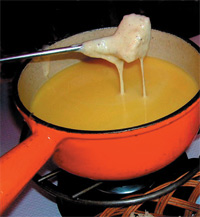
Cheese fondue is served in a ceramic pot. It's mainly melted cheese with some wine and a few other secret ingredients. Dunk dried bread into the cheese. A local speciality. Indeed our restaurant was a local speciality restaurant. We served meat fondue, cheese fondue, raclette, steak tartare (raw minced beef steak) and other high protein feasts.
There were two chefs and myself in the kitchen, a waitress, the owner and his wife. On a busy night we would turn 100+ covers. The French chefs and I kept ourselves fired up with plenty of Dead Kennedys punk classics. They knew all the words.
I was paid about £150 a month. Accommodation included. I paid £60 a month for my season-workers lift pass, then I had some pocket money for ski servicing, beers and food. Slave labour. Loved it.
My main job, apart from washing up was to prepare the desserts. I was an expert at classic ice cream creations such as Banana Split, Peche Melba and Cafe Liegois. The cheese fondues would be stacking up as I prepared the desserts because of course, it's when the main course is brought in that the desserts are then ordered. It's a double whammy because not only have you got more washing up to do you have less time to do it because you're having to prep desserts. Actually, it was really a triple whammy because on a busy night I had to also keep the flow of the crockery and pots back into service. Doing that meant less time for desserts and even less time for washing up.
At 50 fondues a night the system (me) would go into meltdown. Even though I had perfected cleaning fondue pots with a scraper, I was struggling to get the pots back to the kitchen in time and do the desserts. By midnight I had the entire restaurant stock of pots, pans and crockery stacked up in a pile. It would be a long night.
| Try washing up 50 of these |
I learnt a lot those 5 months that I have found useful at work ever since. The main lesson learned though is to watch out for triple whammies. As people add more tasks or projects to the mix they sometimes forget that gives them less time to do the same jobs they already have. Also, if volumes of transactions multiply at the same time they'll have even less time to do the second job and even less time to do the first job. Meltdown is always on the horizon.
So, in a growth company, my advice would be always to think about the proposed operational solution not only in the present, but in the future as well - and in a future where you are doing twice as much business.
Triple whammies happen all the time and when they do the only solution is to dig yourself out of a hole and fix the mess. By then you've probably caused some damage and you may have lost staff, customers or suppliers. That sucks.
You need to know how many cheese fondues is too many.
Thursday, 24 March 2011
Once upon a time in Soho
Wednesday, 16 March 2011
The Smart Arse Rule
You hear people talk about 'working smart'. They might say, it's good to work hard, but it's better to work smart. And then some people insist you can work hard and smart. Oh yeah - and be a parent, husband/wife, healthy, happy, blah blah. Hmmmm.
All of this falls under a conversation in the pub around 'work-life balance'.
Here's the thing. Nothing comes for free in life. If you want results, it requires hard work. In fast moving growth businesses, getting results from putting in a 9-5 day is extremely difficult, almost impossible. Personally I've always wanted to do more in life than work, so I've tried to do that, with moderate success. It gets quite challenging if I'm honest with 4 (lovely) kids aged 2 to 6, a job in a tech start-up and commuting in London.
I don't claim to have balance as such. Nor do I aspire to. Instead I get by and I'm pretty productive at work and have a life outside of work. Rather than describe it as a work-life balance I'd call it 'surviving on the edge of chaos'. To survive, I have a simple rule that I apply when trying to balance the week. It's called the 'smart arse' rule.
Before I explain the 'smart arse' rule and how I've used it, let's touch again on balance. Balancing what? What you want to get out of life is different to me - so this is a really personal thing. For me I need the following; first of all, look after my health. Keep fit, get enough sleep, eat well. If I can do that, everything else follows. Next, pay attention to and look after my family. Maybe that should come first, but to be honest if I'm a grumpy unfit and sleep deprived shell I can't do it very well. So they go hand in hand. And looking after my family means being with them. There's a time requirement, I can't do it on 2 hours a week. It's a big commitment. Part of that involves chores, admin, sorting stuff out and running a household with my wife. Stuff like doing the washing up, moving he lawn, sorting out the car insurance. Blah. And actually spending time with my kids not doing chores. Then there's work. I am ambitious. I want to succeed. Not so that I can rule the world, rather it's really so that I can live life with a purpose and have a sense of achievement in having pushed myself to be the best I can be. What else? A need to learn, to absorb knowledge, to master skills and to teach others those skills. Distil and synthesise thoughts, concepts and continuously chase the answers to big questions.
Just how to survive these chaotic ambitions?
The 'smart arse' rule
About one or two decades ago I worked in a ski resort as an overseas operations manager for an upmarket ski chalet tour operator. I was in charge of everything overseas, which for our company meant 38 chalets in 6 resorts in 3 countries, about 80 staff, 2 childcare centres, 6 vehicles. Logistics, staff management, procurement, contracting, transfer days, troubleshooting. Working in a ski resort sounds like fun, and it can be, but you have to work smart. Really smart. And the way I did this was to have a smart arse rule.
Ask yourself this question - what is the one thing that means more to you than work?
Everyone has something. Even if you're the most driven workaholic entrepreneur, there's always something.
Next - block out your diary with when you will do this activity.
Then - work around this self-imposed rule. If you do this, you're a smart arse and you have a smart arse rule.
In the ski resort, my smart arse rule was this; go skiing at least 3 times a week, 4 times if all goes well. This was broken down into; all day on one day off a week, then 3 afternoons (from 12 to 4) on the day before transfer day (which was often a 18 hour work day), the day after transfer day and one other day depending on my schedule. This sounds like a lot, but even with that I worked about 60 hours a week. I would start at 8am, finish up at 9pm and only go out in the evenings every now and then so as to keep my sleep quota. As far as I was concerned the reason I was busting my gut in a stressful job in the Alps was so that I could go skiing. Without the skiing, the very reason for being there was gone. Skiing was (and still is) my passion.
A real life example of the smart arse rule for city life would be if you are a parent and state that you want to see your kids at bedtime at least every other evening. You allow yourself to work late on some nights if you need to but you block your diary to get home in good time on other nights. Or - you are a football fan and buy tickets to your team's home matches. Or - as a hard working couple, you make a date that Monday evening is movie night. Or - as a martial arts enthusiast you dedicate 3 sessions a week to your passion at certain set times each week.
The important thing is to actually ask yourself what is the one thing more important than work. Then - put these things in the diary up front and commit to them. It could be a simple mental rule rather than a physical diary entry, but until you get this working for you, commit in writing.
The smart arse rule works because it forces you to work smart. You might need to break out your laptop on the train, come in to the office early or schedule an evening conference call to fit everything in, but by committing to yourself first, you actually make it possible to work smart. Then, if you work hard, that's a bonus too, but at least you'll be doing it for a reason.
Without the smart arse rule, how would you know if you are working smart? By forcing yourself to work around self-imposed limitations, you develop skills over time to become effective in delivering your work commitment and at the same time - as a bonus - you reward yourself.
It is possible to work hard and smart. You just need to be a smart arse. Get yourself a smart arse rule.
Wednesday, 9 March 2011
If You Knew You Couldn't Fail, What Would You Do?
I'm lucky to have four kids. I didn't teach them to walk. They didn't teach each other. They just got up and had a go. First of all they started to figure out how to pull themselves up to stand against the furniture. Then they made one or two steps. A few weeks later and they were walking.
We all first learnt by trial and error.
Later in childhood, we start to learn from others. We are taught. We go to school. It's quite amazing to have my eldest daughter read a book to me. She's six. 6 months ago she couldn't read.
We are taught.
There's a third phase. Once we know how things work, we can go figure things out for ourselves. Some kids spend hours playing tennis, some spend hours programming, others spend hours and hours making things. Some of these kids will become the best in the world at what they do. Literally the best in the world. In this phase we practice. We seek guidance, we practice some more. We put hours and hours in. We make mistakes and learn from them. We practice some more.
We are self-taught and we practice.
But then - we become adults. Some people continue with trial and error (It's called 'learning on the job' in the business world. Some are taught (it's called 'training' in the business world). Some practice, work long hard hours, push themselves and become the best in the world at what they do. I'm not sure what we call these people, but I admire them.
I am more thirsty for knowledge now than I have ever been in my life. The more I learn the more I realise there is to learn. And I want to be the best in the world at what I do. Why? It's simple. There's very little in life that beats the feeling that you get when you say 'today I did what I do best!'
Today I will do what I do best. Will you?
Imagine a team where every person can say that. Can you imagine what that team would be able to achieve? It would be extraordinary. World beating. In fact just writing this makes my hairs stand on end - it really is something special. It's like watching the Oxford Cambridge Boat Race and seeing the winners win. It's awesome.
The thing about great teams is, 1 plus 1 equals 3. The sum of the parts is greater than the whole. Only it's not guaranteed. Sometimes two egotistical geniuses equal less than two because they haven't figured how to collaborate well.
So - on a practical note then, how do we build great teams where every person does what they do best and on top of that build a winning team?
How do we make that team possible?
Here, I think are the 5 main ingredients;
1. Allow people to make mistakes.
If we make more mistakes, we learn more. I'm not saying that we should aim to fail. Rather we should always be 'doing'. Doing something means you have the opportunity to learn. If you don't do anything you won't make any mistakes, but then again you won't learn anything. This is the thinking behind the phrase 'fail faster'. It's not that you should aim to fail - instead, you should 'do more faster' - because that's how you'll learn.
Fear holds us back though. We are afraid to make mistakes in case it's not seen as successful by our peers and egos.
My wife and I were talking the other day about why she is successful at what she does. She does business development for a recruitment firm and she needs to figure out how to book meetings with HR Managers and then persuade them to use her firm's services. She said that you can't book meetings without making phone calls, so she has to be very persistent to keep calling until she gets the meeting. She will keep calling way long after other people have given up. Most people fear the rejection, whereas she doesn't.
Her motto is "if you knew you wouldn't fail, what would you do?" Great advice indeed.
So - as a manager, I will always say to my team, 'make decisions and do stuff. Better to do lots and be right 95% of the time than to do a little and be right 100% of the time'. You'll learn faster and so will I.
2. Trust your colleagues and help them to learn from their mistakes
You can only truly build a successful team if there is true openness. I need to be open with my intentions, emotions and reasoning. By doing so, my colleagues can help me identify what I'm doing well and what I can do better and I will learn faster. If I do this though I am opening myself up. I am doing exactly the opposite of what most people do in business. It needs mutual trust, respect and willing - and it needs to start at the top.
3. Design learning structures
A great example of this is how we used to run our software development cycles in one of my previous companies. We planned our work in two week cycles. This was pretty effective in terms of getting things done. The important ingredient I think that actually made it successful was that after every cycle ('sprint') we set up a 'retrospective meeting'. This was a simple meeting where we simply asked, 'what went well, what didn't go so well and how will we in future do more of the good stuff and less of the bad stuff?' Doing this systematically requires a regular meeting slot in the diary, an agenda and a habit. It requires structure.
Good teams consciously create these structures to become learning teams.
4. Hire people that can handle this culture
This is critical. If you believe that you want to build world class winning teams you need to hire accordingly. Sure you need talent and experience. I say they're over-rated.
Just because someone has knowledge and ingredients to make a great cake it doesn't mean that they will. And just because someone was motivated to bake great cakes in the past doesn't mean that they will do so again in a different kitchen.
What really matters is
- does this person know how to apply themselves to a challenge?
- is this person willing to open themselves up and be fully transparent with their emotions, reasoning and intentions?
- are they able to give feedback to others in a helpful way?
- are they thirsty to be the best in the world at something?
5. Go with the flow
You cannot tell people what motivates them. In my experience, people do best what they are interested in, not necessarily what they are good at. I might be quite good at filing and organising paperwork, it doesn't mean I'm interested in it. Give me a reason to be interested in it or find me something to do that I am interested in and I will do it well. Really well.
So - as people develop in your team, find opportunities for them and help them where possible to grow in your organisation to do what they do best. Build the team around the capabilities you have and seek out new team members to fill the gaps if they exist (and make sure you follow the points in point 4).
To conclude
Great parent allow their children to make mistakes, they teach them all they can, and they give them wings to fly and pursue their own dreams.
In a team, we must think of ourselves as parents of each other.
And every day, if we strive to be the best we can be in what we do we'll need to push ourselves to the limit and make a few mistakes. It's the mistakes that lead us to truth.
Benjamin Franklin once wrote,
'Perhaps the history of the errors of mankind, all things considered, is more valuable and interesting than that of their discoveries. Truth is uniform and narrow; it does not seem to require so much an active energy, as a passive aptitude of soul in order to encounter it. But error is endlessly diversified'
Fail faster. Act like a child and a parent at the same time. Be the best in the world at something every day.
Thursday, 17 February 2011
Thermodynamics, evolution, wealth and happiness
a) yawn?
b) laugh?
c) sit up and listen?
If c, read on. Recent reading and thinking has led me to the following conclusion;
Firstly, that the first and second law of thermodynamics hold the keys to the meaning of life. And secondly, progress and wealth are underpinned by an evolutionary mechanism that is universal.
Come again?
I guess I'll need to explain in more detail. I'm not sure I can do it in a single blog post, so bear with me as I fire up a few synapses.
The first law of thermodynamics expresses that energy can be transformed, i.e. changed from one form to another, but cannot be created nor destroyed.
The second law of thermodynamics is an expression of the tendency that over time, differences in temperature, pressure, and chemical potential equilibrate in an isolated physical system.
i.e. - the universe has a finite amount of energy, the universe is an isolated physical system and energy will level out in this system.
The levelling out process is called entropy. In it's most general sense one can regard entropy as the general decay that surrounds us. A new car will eventually rust, a building will need new paint, food will rot, people grow old and stuff just generally falls apart. New life however is sustained by the sun which provides energy for living creatures.
Life requires continued energy to be sustained otherwise it fades and dies. To stay alive, we need to eat and sleep. (Doing nothing is not an option). There's a certain amount of energy required to stay where we are; we have to keep walking forward to stand still. Every day we need our 2 or 3 thousand calories of energy, we need to rejuvenate with our sleep.
If we do more than just stand still it requires effort. If you want to be wealthy, it requires effort. If you want to have a family and prolong your gene-pool, it requires effort. There's effort required to stand still and yet more effort to more forward.
The effect of all of this extra effort is a temporary suspension of entropy.
We strive against a tide of entropy that surrounds us and the efforts we all make on a daily basis help drive humanity forward. We have an inner drive and purpose to temporarily suspend entropy. This drive, this striving, is the essence of life. It gives us satisfaction, it gives us meaning and it gives us value. I would even go so far as to suggest that it is the source of our happiness.
When considering the business landscape, you could see it in this way: businesses competing to create business models that temporarily deliver additional value. Over time, new business models become the norm, become commoditised and so companies need to innovate (strive) to do more than stand still. Those that succeed create wealth, those that don't decay and die.
Behind both humanity and business is a common evolutionary algorithm. This evolutionary algorithm is a method to uncover (not by pre-determined means, but by trial and error), organism designs and business plan designs that are optimal for the environment in which they find themselves.
To make sense of life and to make sense of business, you could like me take the following view;
1. We are part of the fabric of life itself, iterations of the human species that are being continuously tweaked to be optimised for the environment we find ourselves in by an evolutionary method
2. We derive satisfaction (value) by striving to do more than to stand still and to suspend entropy as best we can
3. Businesses work by the same means, combining previous business knowledge into new business designs that can temporarily beat the competition (suspend entropy) and create value. To win they must continuously innovate and embrace evolutionary methods in their architecture.
The laws of thermodynamics, together with an evolutionary mechanic are foundational in understanding the human need to strive and the business need to innovate. One delivers satisfaction and happiness, the other value and wealth. Businesses are but collections of humans so this should be no surprise.
If you are still reading this and wonder what I'm on to deliver such a stream of consciousness, there's two things you should know. I once studied Theology and Religious Studies at University (but am currently an atheist) and that I've recently read "The Origin of Wealth" by Eric Beinhocker. If you get a chance do read Beinhocker, it will help develop the thinking that I've scraped the surface of here.
Saturday, 20 February 2010
Being Human, Implications For Organisations
Language
Emotion
Senses
Memory
I also reckon that if you view an organisation (or company) in the same way, it allows you to figure out how to influence its thinking and behaviour.
This is a tentative conclusion that I’ve reached after discussion and thought over the past few weeks. I’ve been thinking about what elements form the “essence” of our experience and understanding. It started when I realised that we as humans differ immensely from our animal friends in our use of language. Our brains articulate ideas and facts through language and our intentional communication, whether through speech, expression, or text, is rooted in a linguistic thought process. Language is intensely powerful in its ability to convey meaning but if used inconsistently can hide meaning. More about that later.
Then, realising that non-intentional communication (reactive expression for example) is more likely a result of emotion than language, I started to understand that there are some fundamental building blocks that allow the grey matter in our skulls to interact with its environment. There’s language, there’s emotion. Building blocks.
Another core building block (or a set of building blocks of course) are our five senses; sight, hearing, taste, smell and touch. These are inputs that guide us on our way.
For us to learn and to put into context our situation, we have memory. Memory, whether physical or mental, allows us to recognise patterns, store knowledge, build skills and interpret emotions.
These then are four core building blocks of being human: language, emotion, senses and memory.
Mastering these building blocks can lead to integrity, success and contentment.
Implications for organisations
As soon as you realise that these four building blocks exist, and that if they are developed and mature it can lead to integrity, success and contentment, you start to assess an organisation against the four areas.
Language
- Do we use inclusive language? I personally am on a mission to remove acronyms and abbreviations from my communication and where possible to remove it throughout the company. If you don’t know what an acronym means, you feel excluded, or just don’t understand.
- In meetings, does everyone understand the meaning of words? This is especially important in a multi-cultural company. I often pick up on complicated words and ask people to explain them for the benefit of the group. I know I understand the word, but I’m concerned that others might not.
- Do we all have the same vocabulary? What we call things carries immense power. Words convey meaning; therefore what you call something (e.g. “team member”, colleague”, “employee”, staff member”, “worker”) determines many things, not least of all how it affects company culture. Personally I detest the use of the word “department” because it conveys compartmentalisation, and I want to build a company culture of teamwork where the best people work together to get the job done. Naming of products, processes, procedures, office areas, events and job titles all matters. Far more than you can ever imagine. Change the language, change the culture.
Emotions
- Knowing whether we are slaves to our emotions or whether we are acting rationally is an important skill as a human being. Knowing when to listen to your emotions is important in life, and therefore this is also the case within companies. Ego, pride, fear, greediness – these for example are all emotions that a company can evoke in the way it reacts to its environment. Sometimes these are useful, sometimes not, but a company needs to be self-aware to understand if it’s acting emotionally and if so, why this is so?
Senses
- Of course, if we are to make business decisions, it’s good to have accurate information about your environment: your customers, your investors, your team, and your competitors. To gain this information, you need to look and listen, and sometimes, taste, touch or smell (particularly useful in the case of a restaurant business for example). Companies that fail to hone their senses, fail their potential.
Memory
- Winston Churchill said, “Success is going from failure to failure without losing enthusiasm”. By experiencing life we start to understand what works and what doesn’t. Trial and error has always been a certain way to learn. In this context, it’s our memory that serves us, that helps us recognise patterns and to build up intuition.
- As a Firefighter, Chef or CEO, every successful individual has along the way learnt from their mistakes. As a company therefore, how do you help yourself become a learning organisation?
- For a start, recognise mistakes, admit failure. Discuss what could go better next time.
- Also, create methods to store knowledge. People come and go. Whether in the form of documentation or training others, without making an effort to store skills and knowledge, they’ll leak, they’ll fade and you’ll have to re-learn.
If you want in business to create a happy and successful company built with integrity, pay attention to the four building blocks of human experience: language, emotion, memory and senses.
Monday, 2 March 2009
Share Joy, Not Trouble
Recently, when going through my late mother's affairs, I found a small handwritten note used as a bookmark. I think it's my Grandmother's writing but I can't be sure.
Despite not being a believer, I have great respect for the message, especially point 5 (see below) and the last sentence.
1. Have quiet time in the morning and the night.
2. Have a note book handy, don't try to think but rather try to RELAX. Write down any thoughts that do come to you.
3. God cannot speak to you unless you are LISTENING.
4. You can tell him your troubles and RESOLUTIONS and then LISTEN and OBEY.
5. Don't talk to people about your troubles. SHARE your joys with them and even with them LISTEN and they will, in the end, ask you to help them.
Here it is:- "When God speaks Man must LISTEN and OBEY. A changed man can help change the world."