It's the ski season and if you are looking for a ski holiday you could do worse than check out www.ifyouski.com. In fact, to be clear - I love this website!
It's so good to see her keep going, year after year. Ifyouski.com was my first internet job. I joined in August 2000 (shortly after they raised some money from VCs) and now, 13 seasons later, she's still shining.
Ifyouski nearly didn't survive. It had c.£3m of investment and at one point we had about 50 staff. It imploded and was saved/bought by Online Travel Corporation in 2001 for a bargain (it's since been sold again a couple of times). A handful of us kept our jobs. I was one of them, together with Robin Wallace, Max De Grunwald, Rob Van Selm, Tim Barke, Susanne Hedges, Andy Hiseman, Tom Corcoran and Alan Whiteley. Great team.
Ifyouski.com was a very useful website. It still is. It's a well structured fusion of holiday search with great decision support content (resort information, snow reports etc.) So what happened to the £3m? Where did that go?
I was working in a Ski Tour Operator in 2000 and it was the height of the dot com boom. I was excited by the chance to join an internet start up and whilst I didn't know much about startups or the internet, I knew a lot about selling and organising ski holidays. I saw an ad, thought "Yup - that'd suit me" and I joined in a role which would these days be called Product Manager. Back then such job titles didn't exist.
7 years earlier (1993) ex-Olympian skier, Michael Liebreich published a book on ski technique called The Complete Skier. A few years later he took it online as complete-skier.com. It had ski technique content, resort information, snow reports, ski news. It was just stacked full of great ski related content. On top of this a ski chalet holiday search was added as a way of generating some revenue.
As it turns out, a ski chalet holiday search in 1999 was a very useful tool indeed. It still is. The British ski chalet business is fragmented with many small independent operators. In those days, if you were looking for a chalet (say) for 8 people in a specific resort for a specific date from a specific airport you'd have to phone many different operators having read the ads in the Sunday Times travel supplement. To have a website where all of the main operators were listed was fantastic because you could search across many operators at the same time. When you'd found your ideal holiday you could phone the booking office (our travel agent partner) or make an email enquiry. The travel agent made a commission on the booking which they shared with us.
Nice business model. Going strong today.
What happened in 2000 was the company looked to build on it's early success in ski by raising money to launch new sites leveraging the same technology platform. Instead of just ski, the plan was to open up into adventure travel (ifyouexplore), golf (ifyougolf) and scuba diving (ifyoudive). And as well as doing this in the UK, we intended to launch in 3 other countries. Instead of 1 market in 1 country we went head first into 4 markets in 4 countries. Instead of nuturing 1 business model that worked, we developed 1 that worked and attempted to launch another 15 that we didn't know whether they would work or not.
This was an expensive bet to make. Expensive as we had about 50 people (although about 20 of them were interns). In 2000, tech development was costly (we used an agency) and almost everything was proprietary. We had to buy our own servers, write code from scratch (very few open source libraies existed) and create our own content. We didn't know about lean startup methodology.
As it turns out the international businesses and the non-ski businesses didn't deliver a revenue stream fast enough. Some parts of the ski business model simply did not transfer across borders or sectors.
The cash burn was crazy. Back in the dot com boom maybe this didn't seem so crazy. However, unable to deliver the revenues, we were not able to raise further funding and the business was sold.
All that remains now is the one business model that worked; selling ski holidays in the UK via a travel agent using online search.
The lesson I took away from that experience was that any new business model that a company attempts needs to be validated before putting too much investment into it. Validation of the business model requires really understanding the customer segment(s), the distribution channels, the customer relationship methods, the proposition, the key activities and resources, who the key partners are, the cost base and the revenue model.
An excellent way to map this out is using a business model canvas. A business model canvas allows you to capture on one page all of the above points. You can highlight the parts of the canvas that you understand (the "knowns") and the parts you yet need to prove (the "known unknowns"). You can think about the assumptions you are making and then think about how you can go about testing those assumptions. You then systematically run those tests and tweak the model based on the feedback. Once you really have proven all elements of the canvas to a reasonable degree of certainty, you're in a position to start investing money in developing this business model.
I was lucky enough to work with some really great people at ifyouski.com. Many remain true friends. We had a real adventure and managed to leave a legacy which still keeps going today.
The good news is for entrepreneurs today, lean start-up methods have made it easier to validate business models sooner. More tools and platforms exist to support new initiatives and there's a growing workforce of talented designers, developers and marketing folks to call on.
Showing posts with label skiing. Show all posts
Showing posts with label skiing. Show all posts
Monday, 27 January 2014

Tuesday, 12 July 2011
You Can't Always Get What You Want
I was 21 years old, standing about 100m from the stage at the old Wembley Stadium with goosebumps on my arms, thoroughly enjoying the moment.
It was a warm July evening and Mick Jagger was singing to me. Yes, singing to me, directly at me. It wasn't that he was looking at me or anything so obvious. It was his words. "You can't always get what you want, but if you try sometimes, you'll get what you need". They hit me.
Now I'm not sure how I'd managed to be a Stones fan for all of my teenage years without having heard that song. But that's how it was. It was at Wembley that I first heard the song and the timing was perfect.
I'd just graduated from Manchester Uni. It wasn't exactly a celebration. I was in fact quite seriously pissed off. I'd ended up with a grade lower than I had expected. To make matters worse I had missed it by one mark. One mark out of six hundred. You couldn't miss the grade any closer. Despite my appeal to the examiners I could not leave with the grade that I had consistently scored in coursework all through my final year.
So, I was deep down pissed off, knowing I could have done better. It's a horrible feeling, that you let yourself down, but Mick picked me right up and in the course of four minutes turned me inside out and made me feel good again.
"You can't always get what you want, but if you try sometimes, you'll get what you need". The message was clear. You make your own success and it doesn't come free. You've got to work for it. It may not always go your way, but try hard, and you'll get your reward.
6 months later and I was listening to the same song on my Walkman sitting on a chairlift in the sun. I had my skis on and I was trying to see if it was possible to ski every high point and every low point in the Espace Killy ski area (Val D'Isere and Tignes, France). I had decided that I wanted to do a ski season and despite being flat broke with my credit cards maxed out, here I was, soaking up the sun and living the dream. Mick's words sounded better than ever because it was my own bloody mindedness that had made it possible for me to be working in a ski resort. (Oh yes, I skied the entire area that day: non-stop in 6h15).
So, here I am working in an internet start up in 2011. A little older, a little wiser. One thing remains true. Nothing in life comes for free. Success requires effort, persistence and belief. It also requires laser sharp focus and a view on the horizon that we're headed for. Mick was right, it's the trying, the striving, the effort that gets us what we need. No-one does it for you, you've got to make it happen yourself. You've got to try sometimes.
It was a warm July evening and Mick Jagger was singing to me. Yes, singing to me, directly at me. It wasn't that he was looking at me or anything so obvious. It was his words. "You can't always get what you want, but if you try sometimes, you'll get what you need". They hit me.
Now I'm not sure how I'd managed to be a Stones fan for all of my teenage years without having heard that song. But that's how it was. It was at Wembley that I first heard the song and the timing was perfect.
I'd just graduated from Manchester Uni. It wasn't exactly a celebration. I was in fact quite seriously pissed off. I'd ended up with a grade lower than I had expected. To make matters worse I had missed it by one mark. One mark out of six hundred. You couldn't miss the grade any closer. Despite my appeal to the examiners I could not leave with the grade that I had consistently scored in coursework all through my final year.
So, I was deep down pissed off, knowing I could have done better. It's a horrible feeling, that you let yourself down, but Mick picked me right up and in the course of four minutes turned me inside out and made me feel good again.
"You can't always get what you want, but if you try sometimes, you'll get what you need". The message was clear. You make your own success and it doesn't come free. You've got to work for it. It may not always go your way, but try hard, and you'll get your reward.
6 months later and I was listening to the same song on my Walkman sitting on a chairlift in the sun. I had my skis on and I was trying to see if it was possible to ski every high point and every low point in the Espace Killy ski area (Val D'Isere and Tignes, France). I had decided that I wanted to do a ski season and despite being flat broke with my credit cards maxed out, here I was, soaking up the sun and living the dream. Mick's words sounded better than ever because it was my own bloody mindedness that had made it possible for me to be working in a ski resort. (Oh yes, I skied the entire area that day: non-stop in 6h15).
So, here I am working in an internet start up in 2011. A little older, a little wiser. One thing remains true. Nothing in life comes for free. Success requires effort, persistence and belief. It also requires laser sharp focus and a view on the horizon that we're headed for. Mick was right, it's the trying, the striving, the effort that gets us what we need. No-one does it for you, you've got to make it happen yourself. You've got to try sometimes.
Thursday, 28 April 2011
When Is Too Much Cheese Fondue Too Much?
Is there a limit to how much cheese fondue we can handle?
Yes, and it's about 50 servings.
Huh?
Maybe I'm not making sense so I'd better explain myself.
Back in 1990 a young David Norris left university in the midst if a recession with limited career options. (Theology as a degree isn't exactly vocational unless you want to be a priest - and as an atheist I wasn't sure I could be convincing at interview). So, at the relatively young age of 21 I decided I still had time on my side and could do worse than follow my passion.
With student debt to forget, I took the train to Dover in early December, the ferry to Calais and a train to Paris. I muscled through the metro system in rush hour to get a night train south. I woke up in Bourg St Maurice in the French Alps with about £100 to my name and I took a bus to Val D'Isere with my backpack, ski boots, skis and a burning desire to find a way to stay there and ski for 5 months. Nothing else mattered.
I had the advantage of speaking some French. So I knocked on doors for 3 weeks asking for work. I found a place to stay during thus time, sharing an apartment for 3 with 10 other ski bum hopefuls. (Yes, it was smelly, messy and wild). I made friends and it was through a friend that I heard about a job in a restaurant kitchen. Lesson 1: networks bring opportunities.
As my credit card was maxing out I managed to persuade this restaurant to take me on. I was to be a "plongeur". And this is where the cheese fondue comes in. A plongeur is a kitchen assistant and wash up. They didn't know it when they hired me and I didn't know it either but they had just hired the best damn plongeur in history.
I was super motivated. I was getting to ski every single day. I would wake early, be on the first lift and ski to 3 or 4. Then, shower, change, snooze and get to work for 6. Because I wanted to be out early skiing the next day I wanted to fully optimise everything possible and be ready to leave work as soon as possible. The earliest was midnight. On a busy night it might even be 2am.
Cheese fondue is served in a ceramic pot. It's mainly melted cheese with some wine and a few other secret ingredients. Dunk dried bread into the cheese. A local speciality. Indeed our restaurant was a local speciality restaurant. We served meat fondue, cheese fondue, raclette, steak tartare (raw minced beef steak) and other high protein feasts.
There were two chefs and myself in the kitchen, a waitress, the owner and his wife. On a busy night we would turn 100+ covers. The French chefs and I kept ourselves fired up with plenty of Dead Kennedys punk classics. They knew all the words.
I was paid about £150 a month. Accommodation included. I paid £60 a month for my season-workers lift pass, then I had some pocket money for ski servicing, beers and food. Slave labour. Loved it.
My main job, apart from washing up was to prepare the desserts. I was an expert at classic ice cream creations such as Banana Split, Peche Melba and Cafe Liegois. The cheese fondues would be stacking up as I prepared the desserts because of course, it's when the main course is brought in that the desserts are then ordered. It's a double whammy because not only have you got more washing up to do you have less time to do it because you're having to prep desserts. Actually, it was really a triple whammy because on a busy night I had to also keep the flow of the crockery and pots back into service. Doing that meant less time for desserts and even less time for washing up.
At 50 fondues a night the system (me) would go into meltdown. Even though I had perfected cleaning fondue pots with a scraper, I was struggling to get the pots back to the kitchen in time and do the desserts. By midnight I had the entire restaurant stock of pots, pans and crockery stacked up in a pile. It would be a long night.
I learnt a lot those 5 months that I have found useful at work ever since. The main lesson learned though is to watch out for triple whammies. As people add more tasks or projects to the mix they sometimes forget that gives them less time to do the same jobs they already have. Also, if volumes of transactions multiply at the same time they'll have even less time to do the second job and even less time to do the first job. Meltdown is always on the horizon.
So, in a growth company, my advice would be always to think about the proposed operational solution not only in the present, but in the future as well - and in a future where you are doing twice as much business.
Triple whammies happen all the time and when they do the only solution is to dig yourself out of a hole and fix the mess. By then you've probably caused some damage and you may have lost staff, customers or suppliers. That sucks.
You need to know how many cheese fondues is too many.
Yes, and it's about 50 servings.
Huh?
Maybe I'm not making sense so I'd better explain myself.
Back in 1990 a young David Norris left university in the midst if a recession with limited career options. (Theology as a degree isn't exactly vocational unless you want to be a priest - and as an atheist I wasn't sure I could be convincing at interview). So, at the relatively young age of 21 I decided I still had time on my side and could do worse than follow my passion.
With student debt to forget, I took the train to Dover in early December, the ferry to Calais and a train to Paris. I muscled through the metro system in rush hour to get a night train south. I woke up in Bourg St Maurice in the French Alps with about £100 to my name and I took a bus to Val D'Isere with my backpack, ski boots, skis and a burning desire to find a way to stay there and ski for 5 months. Nothing else mattered.
I had the advantage of speaking some French. So I knocked on doors for 3 weeks asking for work. I found a place to stay during thus time, sharing an apartment for 3 with 10 other ski bum hopefuls. (Yes, it was smelly, messy and wild). I made friends and it was through a friend that I heard about a job in a restaurant kitchen. Lesson 1: networks bring opportunities.
As my credit card was maxing out I managed to persuade this restaurant to take me on. I was to be a "plongeur". And this is where the cheese fondue comes in. A plongeur is a kitchen assistant and wash up. They didn't know it when they hired me and I didn't know it either but they had just hired the best damn plongeur in history.
I was super motivated. I was getting to ski every single day. I would wake early, be on the first lift and ski to 3 or 4. Then, shower, change, snooze and get to work for 6. Because I wanted to be out early skiing the next day I wanted to fully optimise everything possible and be ready to leave work as soon as possible. The earliest was midnight. On a busy night it might even be 2am.
 |
| Yes - that really is me |
Cheese fondue is served in a ceramic pot. It's mainly melted cheese with some wine and a few other secret ingredients. Dunk dried bread into the cheese. A local speciality. Indeed our restaurant was a local speciality restaurant. We served meat fondue, cheese fondue, raclette, steak tartare (raw minced beef steak) and other high protein feasts.
There were two chefs and myself in the kitchen, a waitress, the owner and his wife. On a busy night we would turn 100+ covers. The French chefs and I kept ourselves fired up with plenty of Dead Kennedys punk classics. They knew all the words.
I was paid about £150 a month. Accommodation included. I paid £60 a month for my season-workers lift pass, then I had some pocket money for ski servicing, beers and food. Slave labour. Loved it.
My main job, apart from washing up was to prepare the desserts. I was an expert at classic ice cream creations such as Banana Split, Peche Melba and Cafe Liegois. The cheese fondues would be stacking up as I prepared the desserts because of course, it's when the main course is brought in that the desserts are then ordered. It's a double whammy because not only have you got more washing up to do you have less time to do it because you're having to prep desserts. Actually, it was really a triple whammy because on a busy night I had to also keep the flow of the crockery and pots back into service. Doing that meant less time for desserts and even less time for washing up.
At 50 fondues a night the system (me) would go into meltdown. Even though I had perfected cleaning fondue pots with a scraper, I was struggling to get the pots back to the kitchen in time and do the desserts. By midnight I had the entire restaurant stock of pots, pans and crockery stacked up in a pile. It would be a long night.
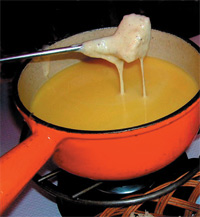 |
| Try washing up 50 of these |
I learnt a lot those 5 months that I have found useful at work ever since. The main lesson learned though is to watch out for triple whammies. As people add more tasks or projects to the mix they sometimes forget that gives them less time to do the same jobs they already have. Also, if volumes of transactions multiply at the same time they'll have even less time to do the second job and even less time to do the first job. Meltdown is always on the horizon.
So, in a growth company, my advice would be always to think about the proposed operational solution not only in the present, but in the future as well - and in a future where you are doing twice as much business.
Triple whammies happen all the time and when they do the only solution is to dig yourself out of a hole and fix the mess. By then you've probably caused some damage and you may have lost staff, customers or suppliers. That sucks.
You need to know how many cheese fondues is too many.
Subscribe to:
Posts (Atom)