When you come out of a room from a meeting with a colleague, do you feel
a) energised?
b) sapped of energy?
c) just the same?
Guess what? Organisations that can scale excellence have a large number of energisers in the team.
This is borne out by a study conducted by University of Virginia's Rob Cross. As referenced in the book "Scaling Up Excellence" by Robert Sutton and Huggy Rao, they say Cross' team found that "successful and innovative organizations have networks that are swarming with interconnected energizers".
I often use this as a rule of thumb when conducting interviews for new hires. If I come out of the room more energised than when I went it it's a very positive indicator. If that candidate can make me buzz with positivity, the thought is that they can do the same inside a team. It's not a given, but it's a useful indicator.
Bear in mind that some people take time to warm up and will give out energy in a different way as you get to know them and as they get to know the team.
It's a useful mental shortcut though when evaluating new hires, especially in a startup teams where positivity is needed to walk through walls and make change happen.
I've blogged before about thinking about whether someone is a "multiplier, adder, subtractor or divider". The energiser is a marker for a good multiplier.
This is a two part equation though... you need energisers but you also need them to interconnect on a regular basis, across teams and functions to spread the positivity. Having an isolated energiser is like stopping the sun shining on a solar panel.
Showing posts with label management. Show all posts
Showing posts with label management. Show all posts
Monday, 3 March 2014

Thursday, 27 February 2014
Running With Slack vs. Running Overheated

Would you run a train network at 100% capacity all the time? No - I don't think you would. There's no slack. If one problem occurs then there's no room to manoeuvre. There'd be a crisis, a meltdown.
In fact - that's one of the problems with London Heathrow airport. It runs at 98% capacity. When bad weather hits, big delays ramp up quickly unless some scheduled flights are cancelled.
So, it stands to reason that as managers we shouldn't try and run our people at 100%. If we do, a crisis will easily happen. We'll then be firefighting instead of growing.
Or - maybe not. The counter view is this: if we are running at less than 100%, we are doing everything with time to spare. Some of that work is less important than the rest. If we say no to things, let's say no to the least important things. If you're saying yes to everything you're not prioritising.
One way to navigate this dilemma is to make a distinction as follows...
Does all the work have to happen within a fixed time frame. Or not?
Predicable fixed tasks with defined time frames - these are best run with some slack capacity to allow for unforeseen circumstances.
Transport and logistics would fit this model. Or fixed deadline civil engineering projects.
Unpredictable tasks with non-defined time frames - these are best queued in order of priority. They can then be worked through at 100% capacity taking a new task from the top of the list as soon as another is completed. If there's a problem, simply pause until the problem is dealt with and then get back to the high priority work.
Software development and creative work might fit better with this model.
Of course, there's no right and wrong here. I'm just highlighting that there are benefits to running with slack and benefits of running with no slack.
Ultimately it boils down to a simple question, "what would happen if we can't complete this by a certain time".
As a startup you're usually running at way above capacity simply because the answer to that question is the amount of cash you have left. At some point however you might need to design slack in your system to avoid a crisis.
As a startup you're usually running at way above capacity simply because the answer to that question is the amount of cash you have left. At some point however you might need to design slack in your system to avoid a crisis.
Friday, 7 February 2014
International Growth - 4 Questions To Help Choose Between Buddism or Catholicism
I was having coffee this week with a CEO of a marketplace business and we were discussing the ways in which he could organise his international expansion.
Do you create local teams that are independent, can act fast and adapt well to the local culture etc. Or - do you do as much as possible from HQ and have as few people as possible on the ground locally?
The truth is, there isn't a simple answer to this question. Either methods can and do work.
I've had this discussion many times over the years and seen different ways of doing it first hand.
The way I see it there are a range of functions which are more suited to being centralised and a range which lend themselves to being more localised.
Finance for example, needs a centralised team. There may be local bookkeepers in each country but usually in finance you'd have as much as possible in one location. Reason; governance and control.
Same with tech. Having a multitude of tech solutions for similar problems means you end up with a spaghetti like mess of code to unpick down the line. Unless there's a business case to say otherwise, tech, design and product tend to stay centralised.
Sales, marketing and customer service are the areas which sometimes can be done centrally, sometimes they need a local presence. There's no "right" answer here because it depends entirely on context.
What I can suggest are 4 questions to ask which might help you decide...
1. Do you need an entrepreneurial mindset to launch in the territory?
If success requires a local entrepreneurial leader to build relationships locally, they will need to be empowered to move fast and independently. They'll need more sales, marketing and customer service resources that they can call on at will. Shackle their ability to move quickly and they will fail.
Later, once a local business is up and running you may choose to start standardising things across territories by sharing best practice but to start with it could make sense to just go hard and fast with an entrepreneurial approach and less standardisation.
2. Do local conditions change the proposition, revenue model or distribution channels used?
If you can use exactly the same methodology in several markets to succeed, much if what is done can be centralised and shared across territories. If it's a very local play with local relationships and local adaptations needed, the set up will be less centralised.
3. Does the business run on policy or principles?
Policy driven companies can be dogmatic and have very specific controlled ways of doing things. Success requires rolling out a template systematically to create a predictable experience for suppliers and customers. (e.g. a hotel booking website)
Other companies can achieve the same results by basing their decisions around a set of guiding principles and giving more autonomy to a local team. (e.g. a recruitment agency).
The difference between these two approaches can be thought of as a "Catholic" versus "Buddist" approach. Great examples can be found in the recently published "Scaling Up Excellence - Getting to More Without Settling For Less" by Robert Sutton and Stanford colleague Huggy Rao.
4. What are the risks of giving up central control?
If a business has developed strategies to reduce risk (e.g. Health and safety risks reduced through certain processes or controls), to allow a local method to manage these risks may not make sense
Finally...
These 4 questions might be a good place to start.
Ultimately, it requires a real life test to decide. If market development approach proves successful and can be replicated time and time again, that's worth something.
As always, test, iterate, amplify or discard.
Wednesday, 5 February 2014
Between the Variables and Constants, People are the Operations - The Mathematics of Team Performance.
In mathematics, "operations" are things like add, subtract, multiply,
divide, squaring, etc. If it isn't a number it is probably an operation.
In business operations however, people are like the mathematical operators. It's people that add, subtract, divide and multiply.
As any business owner will tell you, dealing with people is difficult to get right.
So - here's a tip for any managers out there. If each of your team member were an operation (+, _, X, /), which would they be?
+ ADD +
Someone who adds, adds value. They do their job well, consistently. You need to reward, motivate and nurture these important team members.
- SUBTRACT -
Someone who subtracts is not providing value. They do not do their job well (for whatever reason). You need to address this performance and attempt to turn it around. This may not be possible. If you fail to turn a subtract into an add, you need to remove this person from the team.
/ DIVIDE /
Someone who divides not only does their job badly but causes others to do their job badly as well. They suck up your time. They are a bad influence. They are poison. If you have a divider, you need to realise this quickly and remove them fast. Your team will thank you for this.
x MULTIPLY x
Someone who multiplies not only does their job well but causes others to do a better job as well. They are a catalyst for success. Success breeds success and so if you can have more multipliers on your team, subtractors can become adders and adders become better adders. You need to listen to and empower your multipliers. You also need to make sure they don't get bored or disillusioned. They need to believe in your vision and they will amplify that vision for you. Look after them like the gold that they are.
So, think about your team.
Are you team A?
xxx++++
Or team B?
X++---//
This simple perspective can really help when tough decisions are needed and can help you remember to look after your stars.
In business operations however, people are like the mathematical operators. It's people that add, subtract, divide and multiply.
As any business owner will tell you, dealing with people is difficult to get right.
So - here's a tip for any managers out there. If each of your team member were an operation (+, _, X, /), which would they be?
+ ADD +
Someone who adds, adds value. They do their job well, consistently. You need to reward, motivate and nurture these important team members.
- SUBTRACT -
Someone who subtracts is not providing value. They do not do their job well (for whatever reason). You need to address this performance and attempt to turn it around. This may not be possible. If you fail to turn a subtract into an add, you need to remove this person from the team.
/ DIVIDE /
Someone who divides not only does their job badly but causes others to do their job badly as well. They suck up your time. They are a bad influence. They are poison. If you have a divider, you need to realise this quickly and remove them fast. Your team will thank you for this.
x MULTIPLY x
Someone who multiplies not only does their job well but causes others to do a better job as well. They are a catalyst for success. Success breeds success and so if you can have more multipliers on your team, subtractors can become adders and adders become better adders. You need to listen to and empower your multipliers. You also need to make sure they don't get bored or disillusioned. They need to believe in your vision and they will amplify that vision for you. Look after them like the gold that they are.
So, think about your team.
Are you team A?
xxx++++
Or team B?
X++---//
This simple perspective can really help when tough decisions are needed and can help you remember to look after your stars.
Tuesday, 4 February 2014
Why Growth Companies Struggle With Hierarchy
The way a team works together effectively will change as the number of people in the team increases.
An organisation of 10 people acts very differently to an organisation of 200.
Getting from 10 to 200 can be a difficult journey to manage at the best of times, although in a venture-backed start-up the growth rate is often accelerated artificially such that the number of people joining the company builds the team size quicker than otherwise would be the case. A company who relies on organic growth will not add people as quickly and the adaptation time is slower.
I've experienced this growth challenge several times. It's not easy. Here's why.
I like to use an anthropological analogy to illustrate the point.
A group of 4-10 people will act like a "hunting party". Together they go out on a hunt with a prey in mind but they are very tactical, communicating in real time as the circumstances dictate. There may be a leader and the leader emerges as being the person that all the others defer to and they are happy to be the leader.
A group of 10-40 people will act like "family huts". Imagine that each family has a hut around a central fireplace. Each family has a leader and these leaders and the elders will sit around the fire to share stories and make plans. Life is relatively spontaneous. Everybody knows everybody else, they communicate directly with each other as needed yet they spend more time with their own family than anyone else.
A group of 40-150 people will act as a "small village". In the village everyone has specific roles and there are people in charge of various things. Someone might be in charge of security, another in charge of energy, another in charge of the harvest. Everyone knows everyone else to a degree but things start to get done effectively by using a light hierarchy. Each function has a leader. To get that function to operate effectively, you need to get the leader to instruct their team of specialists to do the job required.
A group of 150 people+ is like a "town" and the default organisation is a strict hierarchy. Large groups like this work through the power of the hierarchy.
(See also "Dunbar's Number, Cross 150 With Caution")
There is a reason why a hierarchy works better when there are more people.
Imagine you have 10 people. 10 people communicate directly with 10 people, verbally, via email, on the phone. That's 10 x 10 potential lines of communication open at all times. 100 threads. If there are 50 people and they do the same thing, it's 50 x 50 = 2500 threads. 5 times as many people creates 25 times as much noise. We can't cope with so much noise. To organise ourselves we naturally create groups and communicate with the group leader who then coordinates the activity of his or her group. Less noise.
The type of person that operates effectively in a hunting party may not like town life. In fact the reason they are a good hunter is because they are not townies. People have preferred methods of organisation and communication, learnt behaviours and default reactions to situations.
A startup might hire some great people when they are small. These great people might not like the environment they find themselves in a couple of years later when a new mode of organisation would be more effective. They still act like it's a hunting party. Those new hires who are used to living in a village or a town join the company expecting things to work like a village or a town because that's the size of the organisation - but they are confronted by hunters who act in a way that they need to adapt to.
The challenge for growth companies therefore is to adapt and change whilst maintaining effectiveness as well as acquiring and retaining talent. Simply being aware of what is happening with the group dynamics helps, as does anticipating changes that might be needed as a result of a changing group size. Communication structures work well if adopted by the majority, that's challenging if there are different expectations within the group.
There's no magic formula, this is human nature we're dealing with. Awareness is a great first step.
An organisation of 10 people acts very differently to an organisation of 200.
Getting from 10 to 200 can be a difficult journey to manage at the best of times, although in a venture-backed start-up the growth rate is often accelerated artificially such that the number of people joining the company builds the team size quicker than otherwise would be the case. A company who relies on organic growth will not add people as quickly and the adaptation time is slower.
I've experienced this growth challenge several times. It's not easy. Here's why.
I like to use an anthropological analogy to illustrate the point.
A group of 4-10 people will act like a "hunting party". Together they go out on a hunt with a prey in mind but they are very tactical, communicating in real time as the circumstances dictate. There may be a leader and the leader emerges as being the person that all the others defer to and they are happy to be the leader.
A group of 10-40 people will act like "family huts". Imagine that each family has a hut around a central fireplace. Each family has a leader and these leaders and the elders will sit around the fire to share stories and make plans. Life is relatively spontaneous. Everybody knows everybody else, they communicate directly with each other as needed yet they spend more time with their own family than anyone else.
A group of 40-150 people will act as a "small village". In the village everyone has specific roles and there are people in charge of various things. Someone might be in charge of security, another in charge of energy, another in charge of the harvest. Everyone knows everyone else to a degree but things start to get done effectively by using a light hierarchy. Each function has a leader. To get that function to operate effectively, you need to get the leader to instruct their team of specialists to do the job required.
A group of 150 people+ is like a "town" and the default organisation is a strict hierarchy. Large groups like this work through the power of the hierarchy.
(See also "Dunbar's Number, Cross 150 With Caution")
There is a reason why a hierarchy works better when there are more people.
Imagine you have 10 people. 10 people communicate directly with 10 people, verbally, via email, on the phone. That's 10 x 10 potential lines of communication open at all times. 100 threads. If there are 50 people and they do the same thing, it's 50 x 50 = 2500 threads. 5 times as many people creates 25 times as much noise. We can't cope with so much noise. To organise ourselves we naturally create groups and communicate with the group leader who then coordinates the activity of his or her group. Less noise.
The type of person that operates effectively in a hunting party may not like town life. In fact the reason they are a good hunter is because they are not townies. People have preferred methods of organisation and communication, learnt behaviours and default reactions to situations.
A startup might hire some great people when they are small. These great people might not like the environment they find themselves in a couple of years later when a new mode of organisation would be more effective. They still act like it's a hunting party. Those new hires who are used to living in a village or a town join the company expecting things to work like a village or a town because that's the size of the organisation - but they are confronted by hunters who act in a way that they need to adapt to.
The challenge for growth companies therefore is to adapt and change whilst maintaining effectiveness as well as acquiring and retaining talent. Simply being aware of what is happening with the group dynamics helps, as does anticipating changes that might be needed as a result of a changing group size. Communication structures work well if adopted by the majority, that's challenging if there are different expectations within the group.
There's no magic formula, this is human nature we're dealing with. Awareness is a great first step.
Sunday, 24 November 2013
How Do You Do?
From time to time, all of us face at work THE REVIEW.
In this article I'll share a tip on how to navigate the review process with confidence. My tip is based around one word, "How".
The review process, normally designed by an enthusiast in HR is imposed on you as a member of the organisation.
If done well, a review meeting can be a very helpful discussion between team member and manager. It does however require preparation on both sides to be worth doing at all.
A review is a reflective process followed by a trusting exchange of opinion and fact. At least that's what it should be. So often however it's a one way affair where either the manager or team member have not taken time to reflect, gather information and organise their thoughts. When neither have done so it becomes a farce and worse than useless.
The sense of trepidation many people feel going into a review either as a manager or as a person being reviewed is sometimes caused by anxiety about the outcome. I'd suggest that it's also caused by a lack of preparation.
Remember the 7 Ps?
If not, here's a reminder; the 7 Ps is a British Army adage for "Proper Planning and Preparation Prevents Piss Poor Performance".
To prepare properly for a review you need 3 things;
1. Something to review against
2. Facts
3. Understanding
Something to review against would normally be previously agreed goals, targets or objectives. If you don't have these for any reason, a job description is a good back up.
Facts are useful. Sounds obvious, but you'll need solid examples, numbers, customer feedback, sales figures, project delivery dates etc.
The understanding piece comes back to the word "how". "How" is the word that can help you prepare better for a review.
"How did I/you achieve X?"
By asking this one question you can identify the positive behaviours that need to be encouraged or highlighted.
It can be used to describe context in a way that facts alone cannot.
It's a useful little word, whichever side of the table you are on.
In this article I'll share a tip on how to navigate the review process with confidence. My tip is based around one word, "How".
The review process, normally designed by an enthusiast in HR is imposed on you as a member of the organisation.
If done well, a review meeting can be a very helpful discussion between team member and manager. It does however require preparation on both sides to be worth doing at all.
A review is a reflective process followed by a trusting exchange of opinion and fact. At least that's what it should be. So often however it's a one way affair where either the manager or team member have not taken time to reflect, gather information and organise their thoughts. When neither have done so it becomes a farce and worse than useless.
The sense of trepidation many people feel going into a review either as a manager or as a person being reviewed is sometimes caused by anxiety about the outcome. I'd suggest that it's also caused by a lack of preparation.
Remember the 7 Ps?
If not, here's a reminder; the 7 Ps is a British Army adage for "Proper Planning and Preparation Prevents Piss Poor Performance".
To prepare properly for a review you need 3 things;
1. Something to review against
2. Facts
3. Understanding
Something to review against would normally be previously agreed goals, targets or objectives. If you don't have these for any reason, a job description is a good back up.
Facts are useful. Sounds obvious, but you'll need solid examples, numbers, customer feedback, sales figures, project delivery dates etc.
The understanding piece comes back to the word "how". "How" is the word that can help you prepare better for a review.
"How did I/you achieve X?"
By asking this one question you can identify the positive behaviours that need to be encouraged or highlighted.
It can be used to describe context in a way that facts alone cannot.
It's a useful little word, whichever side of the table you are on.
Monday, 11 February 2013
Algebra: What is the role of a COO?
The role of a COO (Chief Operating Officer) is not always clear to outsiders. Nor, I would I add, is it always clear to us COO's. It's different from company to company and from time to time.
As a member of the Executive Team, the COO contributes to making decisions on the direction of the company. Figuring out what direction to take and why.
Direction = Vision + Strategy
And for the company to be successful it needs to be capable to pursue that direction.
Success = Direction x Capability
The word "Capability" in the above equation is where the COO has to focus. He/she needs to create and improve the "capability" of the company in order that it can pursue it's objectives effectively.
Digging deeper, capability has two main drivers...
Capability = Competence x Capacity
Competence is how good we are at doing something and it's driven by 4 main factors;
Competence = Communication x Skills x Experience x Information
Capacity however is how fast we are at doing it and it's driven by how many resources we have (money, people, assets) and how productive or efficient we are with those resources.
Capacity = Resources x Efficiency
If the COO is concerned with Capability, then the COO's time by neccessity needs to centre around Communication, Skills, Information, Resources and Efficiency.
That means that COOs tend to think about organisational health, talent, inventory, feedback loops, processes, procedures, controls, systems, planning, reporting and troubleshooting.
So if Success = Direction x Capability
then
Success = (Vision + Strategy) x ((Resources x Efficiency) x (Communication x Experience x Skills x Information))
At least that's the way I understand things, for now.
Thursday, 3 January 2013
What Google Says Makes A Good Manager
The latest issue of Wired UK magazine has a great section on initiatives companies are taking to improve their workplace and culture.


Of note, there's a section on Google's approach to measuring the quality of it's managers.
In 2009 their HR team analysed who were the best and most successful managers and what particular traits they had. This research led them to conclude that there are 8 behaviours that make a great manager and they measure their managers against these 8 behaviours.
The project was called "Project Oxygen" and they call these 8 traits the "Oxygen Eight"...
1. Be a good coach
2. Don't micromanage
3. Express interest in employees' well-being
4. Be productive and results orientated
5. Listen to your team
6. Help employees' career development
7. Have a clear vision
8. Have key technical skills
Spending one to one time with people and taking a genuine interest in their lives was the single most appreciated trait of a manager by their team.
Here's a report in more detail from the NY Times (2011)
1. Be a good coach
2. Don't micromanage
3. Express interest in employees' well-being
4. Be productive and results orientated
5. Listen to your team
6. Help employees' career development
7. Have a clear vision
8. Have key technical skills
Spending one to one time with people and taking a genuine interest in their lives was the single most appreciated trait of a manager by their team.
Here's a report in more detail from the NY Times (2011)
Monday, 24 December 2012
Give In Order To Receive
My Grandmother taught me that the best thing about presents is the giving, not the receiving. There is great pleasure to be had in giving something to someone that they truly appreciate.

It seems true in life that by giving we create goodwill and goodwill has value. Reflecting on this, I realised that great relationships can exist between companies and a) their customers and b) their employees. And it all starts with giving. Giving people what they need.
My bank attracted my attention because they solved a problem
for me. My need. In 1997 my need was that I
didn't want to have to walk down the high street to the bank. It was an
inconvenience. They promised 24/7
telephone banking (and later, when the time came, they provided all of this
online). They made it easy for me to switch my account from my previous bank
and they gave me a cash reward to say thank you.
They provided me with what I wanted, where I wanted it, when
I wanted it and how I wanted it. And
they did it with a smile. I rewarded
them with my business and my recommendation.
It's a very positive relationship.
I realised that the positive relationship
between a customer and a company has many similarities between an employee and
a company. Especially when it goes
right.
Do you manage people?
If you do, don't you wish your team were as positive about
you and as loyal to you as I am to my bank?
Here it seems lies a fundamental truth; your team are your
customers and you are the customer of your manager.
Yes, people management is actually marketing.
In life if we solve other people's problems and provide people
with what they need they will pay us for what they need. That's business. Any business is in business because it solves
a problem or fulfils a need for it's customers. Give in order to receive.
Just as different customers have different needs and
companies provide products and services to meet these needs, people working at
those companies have needs.
You have needs and wants.
You need money to buy food, pay the rent. You probably you want a purpose in life. You will need to feel important and that what
you do with your life matters. You want
to feel in control and therefore free of unnecessary anxiety. You might want friends and need social
stimulation. Maybe you want to learn,
develop and grow as a person. Maybe you
just want recognition and a "thank you". You want information.
Employment can provide for some of these needs. Just as great companies spend a lot of effort
to understand their customers and provide what they need, I believe really
great managers spend time to understand what their team truly need and want and
figure out how to provide it. Employees
reward the company with their effort, creativity and loyalty.
(Note: people don't always know what they want. Phone manufacturers used to think that what
we wanted was a smaller and smaller phone.
It turns out we wanted a big flat screen. We didn't know that. True needs are often
hidden, often driven by emotion not logic.
Your team might say they want to be paid more. This might be not their real need. Their real need might be say, freedom to act,
recognition or purpose. It's often these deep needs that are most powerful).
Think about the best manager that you ever worked for. Think
about the best company that you ever worked for. What needs and wants did they provide for
you? And did you give your effort in
return?
When managers succeed, it's because they provide for these
needs. The need could be a training
opportunity, it could just be encouragement and praise, it could be a fancy job
title, it could be the freedom to make decisions, it could be a company social
event, it could be a clear vision of what the company is trying to achieve, it
could be the sharing of useful information.
When a manager or company gets this right, it seems like magic. It's not magic, it's marketing.
Management is marketing?
Kind of, yes.
First of all then, what is marketing?
Here's the best definition of marketing I've ever heard... "Marketing is creating and value and
extracting value"
- Creating the value is defining a product or service that people are willing to pay for. It includes amongst other things the function, the packaging, the place, the design.
- Extracting value how we get people to pay for that product or service. Communication, pricing etc.
If managing people is like marketing then it is all about creating
value for employees and extracting value from employees. So many managers focus on "extracting
value" when in fact the focus needs to be on "creating value". By creating more value, it's easier to
extract value and to extract more of it.
Think about the relationship a company has with it's
customers...
The best kind of customer is an advocate. The advocate will tell everyone and anyone
about your the great product and service.
Every business wants more advocates.
Then, there are repeat customers.
You like these. Even if they are
not advocates yet, you hope to make them into advocates.
At the other end of the scale are the detractors. Those who really dislike your company and
tell everyone about it. You need to convert these and save this relationship
before it damages your business.
Now think about employees in the same way...
Employee advocates are what I call
"multipliers". They not only
do a great job, they cause others around them to do a great job. They do this because their needs are met. Repeat
customers are your "adders".
They turn up every day and do good work - solid, dependable, but don't necessarily
cause others to do a good job. The detractors are your
"dividers". They not only do a
poor job but they cause friction, discontent and misery around them. You need convert them or remove them if you
can't.
Therefore, address needs and wants to build “multipliers”.
If you can provide for their needs, these multipliers will
go the extra mile, they'll absorb themselves in their work and they’ll recommend
the company to friend.
So many managers act as if they are the customer. In a way that is perhaps technically
correct. At least that's the way the
money flows. The company pays a salary
after all. I however propose that this
is a fundamental error to think this way and although it's counter-intuitive,
we should start to think the other way around. Employees are customers.
If you agree with this approach, as a manager, there are implications;
1. Identify what your team need and want (at both an
individual level and as a group)
2. Provide it
3. Continuously seek feedback if you are on the right track
4. Show appreciation
People management is marketing - the company is the product
and the employee is the customer
Do you agree…?
Wednesday, 17 October 2012
10 Ways For Teams To Do More Useful Stuff
Most managers, most of the time, have a job to do; mostly we manage a team to do stuff.
Sometimes we sit in meetings where ideas flow, sometimes we do deals. However, the nuts and bolts of business is just that; putting together nuts and bolts for other people to buy. (Or in recent years - bytes and bits).
After 20+ years of "getting stuff done" these days as a COO I'm still learning every day about what works. How to organise and coordinate teams in the most effective way. By effective, I mean in the way that creates most value for customers.
If a new manager were to approach me early in their career and ask today, "David, how can I really manage work flow well?", I'd give them the following ten tips. They are what I aspire to myself every day.
Whether it's managing software development teams, call centres, HR projects or staging events, I've found these principles to work. Until recently I hadn't been able to express them clearly. Reading about Japanese production methodologies has helped me reflect on what has worked for me and why.
So, here's my ten tips for getting stuff done well...
1. Make the work flow public
Get the work on the wall. In real time.
These days there are plenty of software solutions to track the status of a project but sadly even the best software fails when it comes to improving team effectiveness. That's because looking at a computer screen is generally not a public process and public processes create peer pressure.
Simply getting the status of the project on a wall and updating it on a daily basis creates awareness amongst all team members and prompts discussions such as, "why is everything stuck in the design phase", "we're not going to hit our target so what are we going to do" or "we're doing well". For example, use post-its that represent tasks that move along between phases of a project, columns for these phases and rows for individuals or sub-teams. Or, in the case of service environments data points such as open cases today, calls waiting, calls successfully answered within 3 rings.
By making the data public and keeping it updated the team starts to work together to address the challenge.
You might think that post-it notes, whiteboards etc are an extra layer of information processing that you don't need if you already track on a computer. Even if there is an extra cost or maintaining real time public work boards I've found the productivity gains to be worth the extra effort. It's counter-intuitive but like most things counter-intuitive it has a surprising effect.
Visual controls. They're very very effective.
2. Go and see the work
You can run all the metrics you like but a good manager needs to be close to the work.
As a Senior Manager this is not practical to do with all the teams that you manage but you still need to periodically "go and see". And literally spend time watching. It's these observations (supported by relevant data) that allow you to make the smart decisions. What's important to fix right now. What's causing the delay / error / problem. Who can help me improve this situation.
A manager is focused on what's closest to him or her. So go to where your customers are and you'll end up focusing on your customers.
3. Be your own customer
I use the word customer in the very broadest sense. Customer can mean consumer, the purchaser of the product or service. Or - a customer could be a supplier. Or - a customer could be a colleague in another team. Basically, if you deliver a service or product to anyone internally or externally, they are your customer.
For example, the finance team are customers of the HR team because they require payroll data from the HR team. The worker getting paid at the end of the month is the customer of the finance team.
Being your own customer can really expose you to the experience of being that customer. What problem is it that you need solved? What does it feel like to have that problem solved by your company? What could be better and why?
At the end of the day, people pay for products and services to solve a problem that they have. E.g. making phone calls (telephone), keeping on touch with friends (social network), self-esteem (fashion), hunger (food), family time (holiday).
If you don't experience the problem and solution yourself you cannot achieve the same level of understanding. Go and be your own customer as a customer would experience it. That helps you to see the value and see the improvements needed.
4. Be able to do the work yourself
Simply sitting with a team creates an awareness that you can't get by sitting in an office next door. Even better, you need to have done the work to truly appreciate what could be improved.
If you can shadow a team member for a day or two, see what it's like to receive the information that they receive, use the tools they use, you are so much more aware of what's important, possible or needed.
Some of the very best managers are those that worked their way up through the organisation from knowing the work in detail from the ground up. They are indeed "grounded" yet have managed to take on senior manager roles. This gives them the ability to have a "helicopter view" and a "ground level view" and they can switch between the two quickly and at will.
This is why it's so important to develop people within a team and train the next generation of leaders from within if at all possible.
5. Reduce work in progress
This is one of the most important and effective principles of all and it's one of the most difficult to achieve. Often we will hear of the importance of focus. Focus is all about deciding what not to do rather than about what to do. It actually about reducing work in progress.
If you have 10 tasks that you are simultaneously working on, you will be switching between tasks a lot. If you have 2 or 3 you can generally work through those in some detail and do them properly. You will actually end up doing more and doing it better. Fact, trust me.
Easy to say, not easy to do. Why?
Think about email as an example. You have a number of projects on the go. You reply to emails, you send emails and that's often because you're collaborating with others to achieve a project goal. Rarely do we work completely alone. The emails that are "sent" go out into the world and one day they might come back with the information you need and you can carry on. In the meantime what do we do? Go to meetings and collect new "to do" actions, plus we reply to whatever is in our inbox. This creates more threads and open items. Everyone else you're working with is doing the same thing and before long the organisation is multi-tasking and task switching adding more and more tasks that get slower and sometimes don't finish at all.
To combat this, discipline is needed. One way to achieve this is to periodically meet as a work group (daily or weekly depending on the group) and identify the top 3 things that matter for the common period and work together on those first every day until they're done. Not 10 things but 3 things.
Work through those 3 things and (here's the important bit), do not start anything new unless you've finished what you can on those 3 things.
You can always create a "queue" to have agreed items next in line once you have spare capacity to "pull" new work onto your schedule.
If you force a limit on the number of items in progress at any one time, the ones in progress move faster and the overall speed of the team improves.
I've found a useful online tool for organising projects and limiting work in progress for this purpose is Kanbanery.
6. Document the process
By writing down your process you have a point from which to measure and optimise it. In fact I would argue that the main purpose of documenting a process is so that you can change it in the future.
The process of documentation (whether it be in words or diagrams) exposes the process to the eyes of the team. You can start to see opportunities to optimise it. Do we really need to do that bit? If we bypassed step 4 would it speed up the process? How many people are involved and could we reduce that? (See point 10).
Go back to the process on a regular basis and ask, "how can we make this process better for our customers?"
Once a team understand that a process is there to be changed and not to be blindly followed without critiquing, it can be very empowering.
7. Measure the flow
How long does it take for a task to go from initiation to completion? Measuring the speed of work but also the variance of work demand is essential to speed up and smooth out the flow. And speeding up and smoothing out the flow (see point 9) leads to better value for all involved.
An example for an HR team; from job requisition approved to offer made, what is our average lead-in time? (And following on from that, what causes the delay in the process and how do we improve that without reducing quality of hires?). If you can measure the flow you can improve it. So go figure out how to measure.
8. Design processes starting with the customer
In any system, there is some kind of end result. Software shipped. Employee hired. Customer enquiry answered. Expenses paid.
When designing processes start with the end customer (either internal or external customer) and figure who sits directly before them in the process. Then who sits before them. And so on. The end customer is "downstream" and the initiator of the process is "upstream".
The process needs to be designed so that the downstream people get what they need when they need it. Then work backwards. This is known as a "pull system". A true pull system provides the quickest path to providing value for the customer.
So many organisations and teams work the other way around. They push things through and you end up with bottlenecks, delays and stress.
This a really tricky principle to pull off well and it requires the buy in of decision makers involved to make it happen. I can't claim to have mastered this myself in all areas of my work. I have however seen it work very well in software development teams that I've managed.
9. Level the flow
What does levelling the flow mean?
In software it means a steady stream of (pulled) productive work without overloading the team with spikes of (pushed) deadlines.
In contact centres it means predicting inbound consumer demand and matching staffing schedules to meet those predicted demands rather than being quite on slow days/hours and overwhelmed on busy days.
Sometimes you'll pull ahead of demand, sometime you'll catch up but all the while your people are steadily adding value in a productive way.
10. Reduce the number of people involved in a task
If a task has 2 people involved and 4 steps it will much faster than if there are 4 people and 4 steps.
If a task has 2 people involved and 4 steps it will be faster than if there are 2 people and 6 steps.
Reducing the steps and the people increases speed and, as long as quality is not decreased, increases value.
Modern companies tend to evolve to create division of labour. This is very useful in fact. A lawyer is better at being a lawyer than a software developer and vice-versa. So for some tasks you need experts. But for others there is division of labour because it's easier to train one person to do one thing than train one person to do many things. Plus, you can pay less for the low value tasks.
So, a simple question to ask is, do I really need this division of labour on this task or do I just need to invest in training?
As customers we hate being passed from one person to another. So as business owners we need to do that only when needed and create multi-talented well trained team.
Recommended reading
The Toyota Way by Jeffery Liker
The Power of Less by Leo Babauta
Kanban by David Anderson
Switch by Chip & Dan Heath
Monday, 17 October 2011
Deadlines
I was reflecting that I've heard you ask me once or twice "what is the deadline for task X"?
I can see that you are driven and respond well to challenges and deadlines. That's great. Really great!
Now I have new challenge for you. The challenge is to move from a deadline mindset to a "flow" mindset. I'm not saying you are stuck in a mindset at all. I want to highlight a way if thinking that I find useful and I hope you do too.
There will always be deadlines. If a task has a deadline, of course I will let you know. I tend however only to work with deadlines that are real. I rarely give deadlines that are self-imposed. Certain things needed to happen by a certain time. Real deadlines for real reasons. For most things though if I set a deadline it would be made up.
Let's talk instead about flow. Flow for me is about having an optimal and predictable regular delivery of value. I've come to like designing processes where we limit the number of things that we focus on things at one time. Why? Because I've observed that the fewer things someone has to do at once the faster they do them. Do less to do more.
The key then is to always ask, what am I already working on that I can finish next? Finish it and once it's finished only then take on a new task. I find I have more predictable delivery.
Then, the second element to a flow method is to make sure that you have a really good understanding of the relative importance of the things on your "to do" list. This can be something you do yourself if you really understand what you are doing in relation to your contribution to the whole organisation. If not, that's where you might need a regular discussion on what's important and why.
There's really only two dimensions of importance; urgency and value. It's obvious that you should do low urgency and low value items last and high urgency high value items first. The more difficult questions are around high urgency low value and low urgency high value. That discussion is never black and white but I'd recommend always focussing on value first unless it's a small effort item and avoid urgency demands by planning ahead.
Anyway, my point is that if you limit the number of things you work on at any one time, consistently finish work in progress before adding new tasks and then always start new tasks based on importance we don't need to use deadlines to deliver great results.
Deadlines are often self imposed. They are useful to many if us because it releases us from the decisions around what to do and what to do next. If you rely on a deadline from your manager instead of figuring it out yourself, you have created a burden for your manager to carry that you could carry yourself.
Real deadlines are real. If there's a deadline I will use the term as it really should be used. For everything else, I believe focussing on flow leads to better results, less supervision and more ownership. Maybe you already knew all of this so forgive me if that's the case.
It's a formula which really works.
I can see that you are driven and respond well to challenges and deadlines. That's great. Really great!
Now I have new challenge for you. The challenge is to move from a deadline mindset to a "flow" mindset. I'm not saying you are stuck in a mindset at all. I want to highlight a way if thinking that I find useful and I hope you do too.
There will always be deadlines. If a task has a deadline, of course I will let you know. I tend however only to work with deadlines that are real. I rarely give deadlines that are self-imposed. Certain things needed to happen by a certain time. Real deadlines for real reasons. For most things though if I set a deadline it would be made up.
Let's talk instead about flow. Flow for me is about having an optimal and predictable regular delivery of value. I've come to like designing processes where we limit the number of things that we focus on things at one time. Why? Because I've observed that the fewer things someone has to do at once the faster they do them. Do less to do more.
The key then is to always ask, what am I already working on that I can finish next? Finish it and once it's finished only then take on a new task. I find I have more predictable delivery.
Then, the second element to a flow method is to make sure that you have a really good understanding of the relative importance of the things on your "to do" list. This can be something you do yourself if you really understand what you are doing in relation to your contribution to the whole organisation. If not, that's where you might need a regular discussion on what's important and why.
There's really only two dimensions of importance; urgency and value. It's obvious that you should do low urgency and low value items last and high urgency high value items first. The more difficult questions are around high urgency low value and low urgency high value. That discussion is never black and white but I'd recommend always focussing on value first unless it's a small effort item and avoid urgency demands by planning ahead.
Anyway, my point is that if you limit the number of things you work on at any one time, consistently finish work in progress before adding new tasks and then always start new tasks based on importance we don't need to use deadlines to deliver great results.
Deadlines are often self imposed. They are useful to many if us because it releases us from the decisions around what to do and what to do next. If you rely on a deadline from your manager instead of figuring it out yourself, you have created a burden for your manager to carry that you could carry yourself.
Real deadlines are real. If there's a deadline I will use the term as it really should be used. For everything else, I believe focussing on flow leads to better results, less supervision and more ownership. Maybe you already knew all of this so forgive me if that's the case.
- Limit work in progress
- Finish before starting
- Deliver regularly and repeatedly
- Start based on importance
- Only use deadlines if they really exist
It's a formula which really works.
Tuesday, 21 June 2011
7 Management Tips Tested on 4 Year Olds
I came down to breakfast today to see a hand written note with childcare tips. My wife had been out the night before with a good friend who we've known for 15 years. Between them they have 7 kids.
On reading the note at first I thought it was a list of childcare tips. After a moment I realised I was mistaken. It was a set of management tips.
Here's the note...
And in case you can't read it here is what it says. 7 tips. I added my own explanations.
1. "Squabbling place" - take time out to discuss why they are arguing
This is the pub. If you can't find a pub a coffee shop might do, but alcohol is always more effective than caffeine. A good old chat solves most arguments. Don't go to bed angry.
2. New rule, repeat new rule
If you want to have your people understand the rules, repeat them until they start saying them back to you. You probably need to say it at least 10 times before anyone hears and 20 times before they listen. Maybe 30 times and they'll understand. 40 times and it might get done that way.
3. Positive praise over a negative situation
Kill negativity with positivity. This is the Richard Branson smile rather than the Alan Sugar frown. Find the bright spots and amplify them, the negativity dries up like a puddle on a summer's day.
4. Sticker for own bum wiping
In business you need to wipe your own bum. No-one else wants to do it for you, so get used to doing your own job. Likewise, make sure your team do their job and that you don't do it for them. Praise any sign that this is happening. It takes 2 years to teach a toddler to wipe their bum properly. It can take longer for managers to let their team do the work.
5. Clear up own mess (e.g split milk)
If you fuck up, clear it up. There's no better way to a P45 than to let others clear up your shit.
6. Own breakfast (youngest 4)
Solve your own problems and encourage your team to do the same. Just don't throw them in the deep end until you've taught them to swim.
7. Find own clothes night before and layout
Encourage your team to make their own plans. Not making plans is not acceptable, however just as kids will get dressed more willingly if they set out the clothes, so will your team be more likely to deliver on plans if they do them, not you.
I can't believe my wife and her pal were talking about work all night. Some people!
On reading the note at first I thought it was a list of childcare tips. After a moment I realised I was mistaken. It was a set of management tips.
Here's the note...
 |
| 7 Management Tips Tested on 4 Year Olds |
And in case you can't read it here is what it says. 7 tips. I added my own explanations.
1. "Squabbling place" - take time out to discuss why they are arguing
This is the pub. If you can't find a pub a coffee shop might do, but alcohol is always more effective than caffeine. A good old chat solves most arguments. Don't go to bed angry.
2. New rule, repeat new rule
If you want to have your people understand the rules, repeat them until they start saying them back to you. You probably need to say it at least 10 times before anyone hears and 20 times before they listen. Maybe 30 times and they'll understand. 40 times and it might get done that way.
3. Positive praise over a negative situation
Kill negativity with positivity. This is the Richard Branson smile rather than the Alan Sugar frown. Find the bright spots and amplify them, the negativity dries up like a puddle on a summer's day.
4. Sticker for own bum wiping
In business you need to wipe your own bum. No-one else wants to do it for you, so get used to doing your own job. Likewise, make sure your team do their job and that you don't do it for them. Praise any sign that this is happening. It takes 2 years to teach a toddler to wipe their bum properly. It can take longer for managers to let their team do the work.
5. Clear up own mess (e.g split milk)
If you fuck up, clear it up. There's no better way to a P45 than to let others clear up your shit.
6. Own breakfast (youngest 4)
Solve your own problems and encourage your team to do the same. Just don't throw them in the deep end until you've taught them to swim.
7. Find own clothes night before and layout
Encourage your team to make their own plans. Not making plans is not acceptable, however just as kids will get dressed more willingly if they set out the clothes, so will your team be more likely to deliver on plans if they do them, not you.
I can't believe my wife and her pal were talking about work all night. Some people!
Thursday, 26 May 2011
Feeling Really Damn Good
I was struck this week by a strong reminder of something I've always believed to be true. If I'm honest with myself though, perhaps I haven't always lived by this belief as much as I could. It was a good reminder.
In a restaurant in Lisbon, I was with two colleagues after a long but good day at work. We were all from different countries but the conversation flowed, we laughed, we relaxed and we were having fun. It was midnight and the night was warm.
We shared stories, jokes and opinions. And in doing so we were revealing ourselves. There were no pretensions, no bragging and no taking the mickey. We were just being ourselves and our appreciation of each other deepened.
So what?
Most people, most of the time in my observation are not true to themselves. They follow other people's rules, wear clothes to fit in with what other people think, say things to create an image of themselves that they want to portray to others. It's pretty rare to just be yourself, especially at work.
As soon as you be yourself, your real self, you have a feeling. I'm not sure I can describe it, but I know it when I feel it.
And when people in groups start being themselves, others do the same. It's contagious and in a good way. Sometimes it can create tension, but at least that tension is transparent, not hidden away. Issues and problems when out in the open are no longer problems, they are opportunities to do something right, to make something happen.
The best performing teams that I've led are the the teams where I've been myself. I'm generally a responsible person but I too have an anarchic side which comes out to play every now and again. In those teams, my maverick nature was not hidden. Equally, my frustration when I wasn't happy with the quality of work performed wasn't hidden either. We did good together, we rocked.
As Primal Scream once noted, "Together we got power, apart we got pow wow".
When each person can be free to be themselves and express themselves through their work they come home at the end of the day knowing they did something meaningful and look forward to waking up and doing more.
High performing teams are honest teams. The first step to an honest team is where people be themselves. Leaders can take the initiative and be themselves first. It takes courage but it feels good. And, paradoxically it's the path to success.
Listening to Eagles Of Death Metal high over the Bay of Biscay, writing down these thoughts I feel good. Really damn good.
Go live. Be yourself, feel good and enjoy the ride.
In a restaurant in Lisbon, I was with two colleagues after a long but good day at work. We were all from different countries but the conversation flowed, we laughed, we relaxed and we were having fun. It was midnight and the night was warm.
We shared stories, jokes and opinions. And in doing so we were revealing ourselves. There were no pretensions, no bragging and no taking the mickey. We were just being ourselves and our appreciation of each other deepened.
So what?
Most people, most of the time in my observation are not true to themselves. They follow other people's rules, wear clothes to fit in with what other people think, say things to create an image of themselves that they want to portray to others. It's pretty rare to just be yourself, especially at work.
 |
| That looks like fun |
As soon as you be yourself, your real self, you have a feeling. I'm not sure I can describe it, but I know it when I feel it.
And when people in groups start being themselves, others do the same. It's contagious and in a good way. Sometimes it can create tension, but at least that tension is transparent, not hidden away. Issues and problems when out in the open are no longer problems, they are opportunities to do something right, to make something happen.
The best performing teams that I've led are the the teams where I've been myself. I'm generally a responsible person but I too have an anarchic side which comes out to play every now and again. In those teams, my maverick nature was not hidden. Equally, my frustration when I wasn't happy with the quality of work performed wasn't hidden either. We did good together, we rocked.
As Primal Scream once noted, "Together we got power, apart we got pow wow".
When each person can be free to be themselves and express themselves through their work they come home at the end of the day knowing they did something meaningful and look forward to waking up and doing more.
High performing teams are honest teams. The first step to an honest team is where people be themselves. Leaders can take the initiative and be themselves first. It takes courage but it feels good. And, paradoxically it's the path to success.
Listening to Eagles Of Death Metal high over the Bay of Biscay, writing down these thoughts I feel good. Really damn good.
Go live. Be yourself, feel good and enjoy the ride.
Thursday, 28 April 2011
When Is Too Much Cheese Fondue Too Much?
Is there a limit to how much cheese fondue we can handle?
Yes, and it's about 50 servings.
Huh?
Maybe I'm not making sense so I'd better explain myself.
Back in 1990 a young David Norris left university in the midst if a recession with limited career options. (Theology as a degree isn't exactly vocational unless you want to be a priest - and as an atheist I wasn't sure I could be convincing at interview). So, at the relatively young age of 21 I decided I still had time on my side and could do worse than follow my passion.
With student debt to forget, I took the train to Dover in early December, the ferry to Calais and a train to Paris. I muscled through the metro system in rush hour to get a night train south. I woke up in Bourg St Maurice in the French Alps with about £100 to my name and I took a bus to Val D'Isere with my backpack, ski boots, skis and a burning desire to find a way to stay there and ski for 5 months. Nothing else mattered.
I had the advantage of speaking some French. So I knocked on doors for 3 weeks asking for work. I found a place to stay during thus time, sharing an apartment for 3 with 10 other ski bum hopefuls. (Yes, it was smelly, messy and wild). I made friends and it was through a friend that I heard about a job in a restaurant kitchen. Lesson 1: networks bring opportunities.
As my credit card was maxing out I managed to persuade this restaurant to take me on. I was to be a "plongeur". And this is where the cheese fondue comes in. A plongeur is a kitchen assistant and wash up. They didn't know it when they hired me and I didn't know it either but they had just hired the best damn plongeur in history.
I was super motivated. I was getting to ski every single day. I would wake early, be on the first lift and ski to 3 or 4. Then, shower, change, snooze and get to work for 6. Because I wanted to be out early skiing the next day I wanted to fully optimise everything possible and be ready to leave work as soon as possible. The earliest was midnight. On a busy night it might even be 2am.
Cheese fondue is served in a ceramic pot. It's mainly melted cheese with some wine and a few other secret ingredients. Dunk dried bread into the cheese. A local speciality. Indeed our restaurant was a local speciality restaurant. We served meat fondue, cheese fondue, raclette, steak tartare (raw minced beef steak) and other high protein feasts.
There were two chefs and myself in the kitchen, a waitress, the owner and his wife. On a busy night we would turn 100+ covers. The French chefs and I kept ourselves fired up with plenty of Dead Kennedys punk classics. They knew all the words.
I was paid about £150 a month. Accommodation included. I paid £60 a month for my season-workers lift pass, then I had some pocket money for ski servicing, beers and food. Slave labour. Loved it.
My main job, apart from washing up was to prepare the desserts. I was an expert at classic ice cream creations such as Banana Split, Peche Melba and Cafe Liegois. The cheese fondues would be stacking up as I prepared the desserts because of course, it's when the main course is brought in that the desserts are then ordered. It's a double whammy because not only have you got more washing up to do you have less time to do it because you're having to prep desserts. Actually, it was really a triple whammy because on a busy night I had to also keep the flow of the crockery and pots back into service. Doing that meant less time for desserts and even less time for washing up.
At 50 fondues a night the system (me) would go into meltdown. Even though I had perfected cleaning fondue pots with a scraper, I was struggling to get the pots back to the kitchen in time and do the desserts. By midnight I had the entire restaurant stock of pots, pans and crockery stacked up in a pile. It would be a long night.
I learnt a lot those 5 months that I have found useful at work ever since. The main lesson learned though is to watch out for triple whammies. As people add more tasks or projects to the mix they sometimes forget that gives them less time to do the same jobs they already have. Also, if volumes of transactions multiply at the same time they'll have even less time to do the second job and even less time to do the first job. Meltdown is always on the horizon.
So, in a growth company, my advice would be always to think about the proposed operational solution not only in the present, but in the future as well - and in a future where you are doing twice as much business.
Triple whammies happen all the time and when they do the only solution is to dig yourself out of a hole and fix the mess. By then you've probably caused some damage and you may have lost staff, customers or suppliers. That sucks.
You need to know how many cheese fondues is too many.
Yes, and it's about 50 servings.
Huh?
Maybe I'm not making sense so I'd better explain myself.
Back in 1990 a young David Norris left university in the midst if a recession with limited career options. (Theology as a degree isn't exactly vocational unless you want to be a priest - and as an atheist I wasn't sure I could be convincing at interview). So, at the relatively young age of 21 I decided I still had time on my side and could do worse than follow my passion.
With student debt to forget, I took the train to Dover in early December, the ferry to Calais and a train to Paris. I muscled through the metro system in rush hour to get a night train south. I woke up in Bourg St Maurice in the French Alps with about £100 to my name and I took a bus to Val D'Isere with my backpack, ski boots, skis and a burning desire to find a way to stay there and ski for 5 months. Nothing else mattered.
I had the advantage of speaking some French. So I knocked on doors for 3 weeks asking for work. I found a place to stay during thus time, sharing an apartment for 3 with 10 other ski bum hopefuls. (Yes, it was smelly, messy and wild). I made friends and it was through a friend that I heard about a job in a restaurant kitchen. Lesson 1: networks bring opportunities.
As my credit card was maxing out I managed to persuade this restaurant to take me on. I was to be a "plongeur". And this is where the cheese fondue comes in. A plongeur is a kitchen assistant and wash up. They didn't know it when they hired me and I didn't know it either but they had just hired the best damn plongeur in history.
I was super motivated. I was getting to ski every single day. I would wake early, be on the first lift and ski to 3 or 4. Then, shower, change, snooze and get to work for 6. Because I wanted to be out early skiing the next day I wanted to fully optimise everything possible and be ready to leave work as soon as possible. The earliest was midnight. On a busy night it might even be 2am.
 |
| Yes - that really is me |
Cheese fondue is served in a ceramic pot. It's mainly melted cheese with some wine and a few other secret ingredients. Dunk dried bread into the cheese. A local speciality. Indeed our restaurant was a local speciality restaurant. We served meat fondue, cheese fondue, raclette, steak tartare (raw minced beef steak) and other high protein feasts.
There were two chefs and myself in the kitchen, a waitress, the owner and his wife. On a busy night we would turn 100+ covers. The French chefs and I kept ourselves fired up with plenty of Dead Kennedys punk classics. They knew all the words.
I was paid about £150 a month. Accommodation included. I paid £60 a month for my season-workers lift pass, then I had some pocket money for ski servicing, beers and food. Slave labour. Loved it.
My main job, apart from washing up was to prepare the desserts. I was an expert at classic ice cream creations such as Banana Split, Peche Melba and Cafe Liegois. The cheese fondues would be stacking up as I prepared the desserts because of course, it's when the main course is brought in that the desserts are then ordered. It's a double whammy because not only have you got more washing up to do you have less time to do it because you're having to prep desserts. Actually, it was really a triple whammy because on a busy night I had to also keep the flow of the crockery and pots back into service. Doing that meant less time for desserts and even less time for washing up.
At 50 fondues a night the system (me) would go into meltdown. Even though I had perfected cleaning fondue pots with a scraper, I was struggling to get the pots back to the kitchen in time and do the desserts. By midnight I had the entire restaurant stock of pots, pans and crockery stacked up in a pile. It would be a long night.
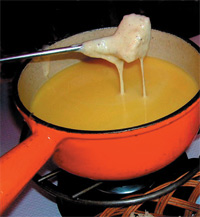 |
| Try washing up 50 of these |
I learnt a lot those 5 months that I have found useful at work ever since. The main lesson learned though is to watch out for triple whammies. As people add more tasks or projects to the mix they sometimes forget that gives them less time to do the same jobs they already have. Also, if volumes of transactions multiply at the same time they'll have even less time to do the second job and even less time to do the first job. Meltdown is always on the horizon.
So, in a growth company, my advice would be always to think about the proposed operational solution not only in the present, but in the future as well - and in a future where you are doing twice as much business.
Triple whammies happen all the time and when they do the only solution is to dig yourself out of a hole and fix the mess. By then you've probably caused some damage and you may have lost staff, customers or suppliers. That sucks.
You need to know how many cheese fondues is too many.
Saturday, 23 April 2011
Why COOs love roundabouts
Approaching a roundabout one early morning last week, I was riding to work on my bike, crossing through Richmond Park. It was relatively quiet with a few cars and bikes and the deer were happily munching on grass in the fresh morning air.
I sailed through the roundabout without slowing down. Almost at the same time but not quite, another bike came through from another direction. And a few moments after that a car flew through. None of us slowed down, we didn't need to. It was all fluid, smooth and unintentionally synchronised.
At that time there was no need for a roundabout. We could have all managed without one. Later in the day however, with more traffic, a roundabout would become very beneficial. Someone had wisely built one.
A roundabout is both a physical technology and a social technology. Physical because it requires certain techniques and materials to build, social because it requires rules and behaviours to have benefit. We developed roundabouts to solve a volume and interaction problem.
Growing companies have the same challenges as the road traffic network. As volume and traffic builds, more processes and organisational structure (social technologies) are needed. Plus, more servers and work space are needed (physical technologies).
The CEO sets the direction. He/she says, "this the horizon we're headed towards and here's why". It's a "what" and a "why" focus. The COO however takes responsibility for how we reach that horizon, getting the right team together at the right time, building enough (but not too much process), find the best way to make the team perform together. It's a "who, when, how much" focus.
As a COO therefore I need to figure out if give way signs, roundabouts or traffic lights are needed. I need to build junctions and roads and I need to do so with a sharp eye on making sure the costs and revenues are supporting that investment.
With a tech start up, the COO role is particularly relevant. How many people to hire, in what order, how many servers to pay for, building systems for organisational effectiveness...these things are always important in any business, but in a tech start up the impact is amplified many times over. Some companies grow at 10 to 20 percent a year in revenue, people and infrastructure. For start ups, add a zero to any number. 10 times as fast. Traffic can hit your junctions pretty quickly and you need to know whether to put in place a give way sign, stop sign, roundabout, traffic lights or flyover.
That challenge of building a team and product to make possible a vision is one I love. I guess that's why I'm a COO. I love roundabouts.
Wednesday, 13 April 2011
Stay on the Yellow Brick Road

The path most travelled and the path of least resistance are often the same.
On a recent supermarket trip I was at the check-out. I saw the usual chewing gum, cooking magazines, batteries and chocolate on display. High profit items that customers impulsively buy as they wait to pay for the rest of their goods. I wonder, if supermarkets had to rely on people only buying what they came to the shop to buy, would they actually make a profit at all?
On this occasion, I had to deal not only with the persuasion of my inner self ('hmmm, I really fancy some chocolate right now') but also with the persuasion of my kids who were asking for lollipops and magazines with free plastic toys. To avoid giving in to my kids I felt it necessary to not yield to myself as well. In the process, our local supermarket missed a few extra pounds profit and our family saved some unnecessary expense.
Marketing folks have of course always understood that to generate a customer response they need to place the goods and services as close to the customer's existing path as they possibly can. The supermarket checkout is a classic example and has been taken to new extremes these days by almost every retailer. If I try and buy a bottle of water at the airport at the newsagent or chemist I will inevitably meet with a queuing system that sees me waiting for the next available checkout whilst I have a chance to view almost all the high profit impulsive purchase products that the retailer has to offer. Chocolates, crisps, suncream, ear-plugs, travel pillows, tissues....the aim is to convert paying customers to higher paying customers.
Marketing folks online also get this. Why do you think Google Adwords has been so successful at generating results for marketeers? Because the potential customers are already there. In this case the challenge is not to convert an existing customer, the challenge is to acquire a new customer. As we know that potential customers are already on Google (and we know their intentions from their keywords) we can take advantage of their existing path and offer them our products and services.
Likewise with TV advertising. You wouldn't ask parents to 'please come downtown tomorrow to view the new home cleaning product advert on a big screen'. No, you'd probably put the advert on a kids TV channel hoping they'd see it whilst they watch TV with their kids.
The best way to make change happen is to find and use the path most travelled.
Managers in businesses however don't quite get this. If they have a program of change that they want to achieve, they need to think marketing and they need to think about distribution channels, paths and existing behaviours. So many don't.
It's essential to start thinking about internal comms in the same way as external comms. Who are my audience? Where can I reach them? How do I integrate my message into their existing behaviour? How can I get the results I want from their existing environment?
In a previous job, our tech team were trying to figure out how to build knowledge and awareness within the customer support team about how our products worked. Their solution, although commendable for the effort put in, was ineffective. They decided to create blog and wiki where they would explain how things worked. New posts would be available by RSS feed.
What needed to happen for this to work was that all the customer support people needed to have a separate login for the wiki. Then, they all needed to configure their email client to pick up the RSS feed. Then they needed to remember to check the RSS feed folder in their inbox on a regular basis and read the articles. Sounds dead easy if you work in tech. It failed.
Imagine if our supermarket had a separate room for all of their high margin add-on sales. You had to go there specifically in order to see the product offerings. And you needed to pick up a separate basket in order to carry these products to the check-out in addition to your main trolley. They wouldn't sell anything would they? Of course, not.
The path most travelled is why the supermarket check-out system works for the add on sales. The path most travelled is also the reason the tech wiki failed.
For the tech wiki project to work it needed to use the systems that the customer support staff were already using on a daily basis. There were three; the company back office system, the CRM database and email. Anything outside of these three systems was irrelevant because support staff were busy enough dealing with these three systems to think about adding another.
So, when trying to introduce a change to an organisation, focus on making your change happen using existing pathways. Making change happen is hard enough. Having to create new pathways at the same time makes it even harder.
As a bonus, not only is the path most travelled the easiest place to introduce your change, it's also the path of least resistance.
No matter what their discipline or function, the more a manager thinks like a marketeer, the most likely he or she will succeed. Be where people are and be where they are receptive.
Find and use the path most travelled. It could be your yellow brick road.
Thursday, 24 March 2011
Once upon a time in Soho
I was having lunch with a friend in a lovely vegetarian café in Soho this week and we were talking about work. He and I work in different companies, different jobs, but we share an interest in how the world works and a desire to learn.
He said, 'The bit I don’t get, is how to get my point across to the decision makers. I can blind them with logic, I can build a great presentation….'
He was struggling with what so many of us struggle with, influencing others. A few moments later we went back to the topic and I said, 'So, what other ways are there do you think to get a point across?' He started thinking out loud and after a few sentences he started getting warmer when he said, 'metaphor'.
I find that most people use a, rational approach, a deductive logical approach to solving problems and indentifying opportunities. Think it through, understand cause and effect, then put a solution together. The trouble is if you want others to adopt your solution, telling them so in a rational way doesn’t have the impact and influence.
How to get your point across?
I said to my friend, 'You could tell a story. Stories capture attention because we’ve been wired for tens of thousands of years to communicate using stories'. (For example, Jesus told parables, he didn’t state a moral code as such – he explained what people living that code did). I went on, 'it may be that you had a vivid conversation with a customer about your product and this validates the conclusion you came to using data and logic. If you tell the story first, then provide supporting data, you’ll have way more impact'.
(Of course – be sure to tell stories that support your rational conclusions, not the other way around. Anecdote is not data. Fool others, but don’t fool yourself – be sure the data supports the anecdote).
We continued our conversation and discussed the presentation methods and sales techniques that really work. Logic featured as back up, not a leading strategy. Other than stories, we identified using imagery, analogies and experiences.
It’s no co-incidence that I started writing this blog post as a story. I was hoping it would capture your attention better than it would if I just started out with explaining how to get a point across. Well did it?
Remember – we have two brains. A logical one and an emotional one. The emotional one always wins the battle for influence and the triggers you can use (stories, images, experience, patterns) are very different to the way in which you came up with the solution (logic, analysis, reasoning).
So, by all means solve a problem. To get others to act on your solution figure out how you can tell a story.
My friend and I will be meeting up in another month. Maybe I’ll bring you back another story.
Subscribe to:
Posts (Atom)