Where do you get your ideas?
I get my best ones in all sorts of strange places. In the shower, walking for the bus, on my bike. Rarely do ideas come to me at my desk.
Archimedes had his "Eureka" moment in the bath. You might do too.
CEOs seem to have ideas at the weekend. That's no co-incidence.
Creativity is an elusive thing. Try too hard and you'll not get anywhere. Ideas seem to have a life of their own and they are definitely not 9-5 office workers.
Here's something I learnt about ideas which really has helped me find more of these little creatures.
If I think about a problem hard and consciously, if I try to start solving it, even if I don't solve it, it plants a seed in my brain. My conscious mind works on the problem. Unless I've solved this problem before, rarely will a new idea form from conscious thought.
It's the unconscious mind which unlocks ideas. How scientifically true this is I cannot say. From experience though, I can say for sure that your unconscious mind continues to work on a problem long after your conscious mind has switched off.
You can be daydreaming in the shower and then pow! It comes to you. Taking that idea back into the conscious world you can do something with it and get cracking.
If you are short of ideas, discuss the issue at hand with someone and then leave it for a day or two. The unconscious mind will work it over and you might come up with new ways of looking at the situation.
Getting started is often the most important thing you can do. Just start the thinking consciously. Then pause. Reflect (not consciously). Wait. Discuss again. Reflect.
To really tune into a problem you sometimes need to tune out.
Showing posts with label learning. Show all posts
Showing posts with label learning. Show all posts
Tuesday, 10 December 2013

Wednesday, 2 October 2013
Just ask
 |
| Picture courtesy of Andrew Kidd |
This morning I was asked "why" questions, one after the other. A barrage of questions about why things are the way they are. This wasn't in a team meeting or a management discussion. It was over the breakfast table with an insistent four year old.
That's the thing about four year olds, they just ask you straight up. They're not worried about what you think of them, they just want to know. It's a natural curiosity.
Some of the greatest minds in human history kept asking questions long after the age of four. Some of the best never stopped.
I recently resumed learning to play guitar after a 25 year gap. This time around I have a massive advantage because I can find the answer to almost any question straight away. How do I play a specific song? Look it up on YouTube and there are plenty of people ready with a show and tell.
There's a revolution in online learning happening right now thanks to the internet. That's the difference that the last 25 years have given us. Universities such as Stanford are putting entire courses online. Wikipedia is available almost anywhere, anytime to anyone. Put it this way, if you have a question, it's never been easier to find an answer.
The ability to ask the right questions is an underrated skill. If I were interviewing someone for a job, I am much more interested in the questions they ask than the answers they give. The ability and willingness to ask useful and insightful questions is the mark of someone that applies themselves to a problem and who will overcome obstacles.
It's never been more important than now to keep asking questions. As an adult it's a habit and skill we need to nurture. The good news is that it's never been easier to get answers.
This gives me great optimism for humanity and the world that today's 4 year olds will inherit.
It also is a humbling reminder that today like every day I need to keep asking questions.
Friday, 1 March 2013
"If You're Going Through Hell, Don't Stop"
You start your holiday with excitement and energy. Woo-hoo! No more work for two weeks, we're off!
How long does that feeling last? When do the arguments start? Unless you're off back-packing by yourself, you'll be either with friends or family or both.
Here's typically what happens;
Day 1 - excitement, chatter, interest in other people, sharing plans, news and celebrating
Day 2 - more of the same, just a little slower but you're still all on best behaviour
Day 3 - starting to get tired, needing a little more space and time, starting to make less effort towards each other
Day 4 - the arguments start. You can no longer maintain the being on best behaviour at all times. You start to say what you really think. Others do the same. A few disagreements maybe. Maybe a full blown out row or face off
Day 5 - you start to adjust to your real travelling companions, their needs and wants, your own needs and wants, your new environment and living space, maybe a few apologies, a few honest and frank conversations
Day 6 - now you're all just being yourself and relating to others in a truthful way, you start to find ways to enjoy yourselves together on this new level
Day 7 - you're more relaxed, start to enjoy the holiday for what it really is
Day 8 onwards - you're having a great time
Does that ring a bell? Have you ever been in a holiday situation like that?
The pattern repeats itself whenever a new member joins the group or there is some kind of instability such as a change in environment. You all go back a few steps until you readjust.
The pattern has a name, you might have heard it before... Form, Storm, Norm, Perform
Form - the honeymoon period, everyone is on their best behaviour
Storm - the truth comes out, friction and strife
Norm - adjusting to the reality of the group
Perform - getting the best out of the group in a truthful way
This pattern doesn't just apply to holidays. It applies to any new collaboration of two or more people.
It applies to relationships. Remember those first 6 months? That's the form period. Some people come off that 6 month period wondering what happened. You're suddenly arguing about things you never used to argue about. Here's the truth - it's completely normal to have these arguments (storm). You need to get through them and accept the other person for who they truly are (norm) before you can be strong as a couple (perform)
It applies to companies. New people join a company and go through their own form storm norm perform before they truly settle. Some people just get out at the storm stage but others will persist and that's the route to performance.
It applies to projects. There's always a doom and gloom middle part of the project where the project manager feels like it's never going to happen. But it does.
It applies to sport. Setting out (form) on the path to glory (perform) requires a lot of soul searching and pain as you put the training in (storm and norm) to become the athlete you want to become.
In applies to studying. Learning a new skill is exciting at first (form), but you realise that it's very difficult to commit and put the hours in (storm) and until you manage to do that consistently (norm) you won't succeed (perform).
I've observed this pattern many many times in life and it's helped me enormously. When the euphoria of a new start wears off I think "hey - this is perfectly normal and to be expected - let's keep going" and it gives me strength. My expectations are more realistic and I'm less prone to reacting badly to when things go wrong. I had to learn this the hard way. Simon, my manager when I was at Eurocamp said observantly, "David, you don't like it when things go wrong, do you?" He was right of course. That's still the case, I like to get things right first time. Now I realise that is an ideal and the real world will hit me hard and I need to push through to see the success on the other side.
As Winston Churchill famously said, "If you're going through hell, don't stop"
Further reading....
Wikipedia Tuckman's stages of group development
Friday, 16 November 2012
Dr M
I met Dr M on the walk back from the train station today.
It was the first time that I realised that was his name. He'd bounced in and out my life over the past few years but he's never told me his name.
You see the thing is, Dr M is not a real person. He's an idea.
He's what will make your life different in the next year. And like the Holy Trinity there's three parts to his character.
D = Do
R = Read
M = Meet
These are the three things that will change your life in the next year
- what you do
- what you read
- who you meet
Do
I learn by doing. By trying things out, I develop skills, knowledge and understanding. I also put myself into new challenges, see new problems, find new solutions.
Read
Reading is nourishment for the mind. Ideas are planted, mental frameworks are thrown around, concepts are born, knowledge is gained. Ideas were born to have sex with each other. The more you read, the more ideas you have and these ideas synthesize with others to create new views of reality.
Meet
We are social animals. I find that it's by meeting with others, having conversations and doing things together that I learn new things, hear of new opportunities and (importantly) have fun.
Mix it all up
The great thing about Dr M though is when you mix it all up. Doing things, reading and then meeting up creates all sorts of new perspectives and opportunities. Reading about an idea and then trying it out. Debating ideas with others. Sharing your knowledge with others. The power is of the combinations. D+R, R+M, M+D. It's the algebra of life.
If you want good things to happen to you, remember Dr M.
Do more stuff. Read more books. Meet more people.
It was the first time that I realised that was his name. He'd bounced in and out my life over the past few years but he's never told me his name.
You see the thing is, Dr M is not a real person. He's an idea.
He's what will make your life different in the next year. And like the Holy Trinity there's three parts to his character.
D = Do
R = Read
M = Meet
These are the three things that will change your life in the next year
- what you do
- what you read
- who you meet
Do
I learn by doing. By trying things out, I develop skills, knowledge and understanding. I also put myself into new challenges, see new problems, find new solutions.
Read
Reading is nourishment for the mind. Ideas are planted, mental frameworks are thrown around, concepts are born, knowledge is gained. Ideas were born to have sex with each other. The more you read, the more ideas you have and these ideas synthesize with others to create new views of reality.
Meet
We are social animals. I find that it's by meeting with others, having conversations and doing things together that I learn new things, hear of new opportunities and (importantly) have fun.
Mix it all up
The great thing about Dr M though is when you mix it all up. Doing things, reading and then meeting up creates all sorts of new perspectives and opportunities. Reading about an idea and then trying it out. Debating ideas with others. Sharing your knowledge with others. The power is of the combinations. D+R, R+M, M+D. It's the algebra of life.
If you want good things to happen to you, remember Dr M.
Do more stuff. Read more books. Meet more people.
Monday, 2 May 2011
Why Your Weaknesses are Your Strengths
My grandma once told me a story about how my younger self was prone to impulsive urges.
We were walking past a shop and in the window was a toy car. I really wanted that toy car and started pleading with my grandma to buy it.
She asked me how much pocket money I had and whatever I had was not enough. She said that we could come back on the weekend when I would have received some pocket money and have had a chance to save up for it.
I was not happy. I did not want to wait until the weekend. I can't imagine it was a pleasant scene. Still, my Grandma (rightly so) stood firm and we did not buy the car. Not then and not at the weekend because by then I was no longer interested in the car.
She told me this story about my younger self when I was a teenager. She said she was worried about my impulsive nature. It's true, I do have an impulsive nature. And I love it. I've learnt to control spending urges, but there have been many times in life when this side of my character has served me well. I've done many unusual things in life that have left a richness of experience and that in part is due to my willingness to make instant decisions and "do".
Impulsiveness can be a weakness, it can also be a strength. The same is true I find of most personality traits. It all depends on context. Most traits have a use so if you can understand better who you are and put yourself into situations that suit your personality, you'll find a good path.
Very persuasive, tenacious and curious? Great if you are an investigative journalist or sales person. Not very good at writing? Perhaps sales works better for you than journalism.
I don't actually believe that we have "strengths" or "weaknesses". I believe instead that we all have certain personality traits that are amplified, that we use and abuse and that in the right context can be a strength.
Therefore if you are interviewing for a job, either as a candidate or as a recruiter, consider it a dating game. You're both trying to assess if this person is the right "fit" for the job. The right person for the job may well be narcissistic, impetuous and driven by self-doubt. Or gregarious, conservative and self-confident. Or not. It's all about the fit at that moment in time.
There are no strengths and weaknesses, only context.
We were walking past a shop and in the window was a toy car. I really wanted that toy car and started pleading with my grandma to buy it.
She asked me how much pocket money I had and whatever I had was not enough. She said that we could come back on the weekend when I would have received some pocket money and have had a chance to save up for it.
I was not happy. I did not want to wait until the weekend. I can't imagine it was a pleasant scene. Still, my Grandma (rightly so) stood firm and we did not buy the car. Not then and not at the weekend because by then I was no longer interested in the car.
She told me this story about my younger self when I was a teenager. She said she was worried about my impulsive nature. It's true, I do have an impulsive nature. And I love it. I've learnt to control spending urges, but there have been many times in life when this side of my character has served me well. I've done many unusual things in life that have left a richness of experience and that in part is due to my willingness to make instant decisions and "do".
Impulsiveness can be a weakness, it can also be a strength. The same is true I find of most personality traits. It all depends on context. Most traits have a use so if you can understand better who you are and put yourself into situations that suit your personality, you'll find a good path.
Very persuasive, tenacious and curious? Great if you are an investigative journalist or sales person. Not very good at writing? Perhaps sales works better for you than journalism.
I don't actually believe that we have "strengths" or "weaknesses". I believe instead that we all have certain personality traits that are amplified, that we use and abuse and that in the right context can be a strength.
Therefore if you are interviewing for a job, either as a candidate or as a recruiter, consider it a dating game. You're both trying to assess if this person is the right "fit" for the job. The right person for the job may well be narcissistic, impetuous and driven by self-doubt. Or gregarious, conservative and self-confident. Or not. It's all about the fit at that moment in time.
There are no strengths and weaknesses, only context.
Thursday, 28 April 2011
When Is Too Much Cheese Fondue Too Much?
Is there a limit to how much cheese fondue we can handle?
Yes, and it's about 50 servings.
Huh?
Maybe I'm not making sense so I'd better explain myself.
Back in 1990 a young David Norris left university in the midst if a recession with limited career options. (Theology as a degree isn't exactly vocational unless you want to be a priest - and as an atheist I wasn't sure I could be convincing at interview). So, at the relatively young age of 21 I decided I still had time on my side and could do worse than follow my passion.
With student debt to forget, I took the train to Dover in early December, the ferry to Calais and a train to Paris. I muscled through the metro system in rush hour to get a night train south. I woke up in Bourg St Maurice in the French Alps with about £100 to my name and I took a bus to Val D'Isere with my backpack, ski boots, skis and a burning desire to find a way to stay there and ski for 5 months. Nothing else mattered.
I had the advantage of speaking some French. So I knocked on doors for 3 weeks asking for work. I found a place to stay during thus time, sharing an apartment for 3 with 10 other ski bum hopefuls. (Yes, it was smelly, messy and wild). I made friends and it was through a friend that I heard about a job in a restaurant kitchen. Lesson 1: networks bring opportunities.
As my credit card was maxing out I managed to persuade this restaurant to take me on. I was to be a "plongeur". And this is where the cheese fondue comes in. A plongeur is a kitchen assistant and wash up. They didn't know it when they hired me and I didn't know it either but they had just hired the best damn plongeur in history.
I was super motivated. I was getting to ski every single day. I would wake early, be on the first lift and ski to 3 or 4. Then, shower, change, snooze and get to work for 6. Because I wanted to be out early skiing the next day I wanted to fully optimise everything possible and be ready to leave work as soon as possible. The earliest was midnight. On a busy night it might even be 2am.
Cheese fondue is served in a ceramic pot. It's mainly melted cheese with some wine and a few other secret ingredients. Dunk dried bread into the cheese. A local speciality. Indeed our restaurant was a local speciality restaurant. We served meat fondue, cheese fondue, raclette, steak tartare (raw minced beef steak) and other high protein feasts.
There were two chefs and myself in the kitchen, a waitress, the owner and his wife. On a busy night we would turn 100+ covers. The French chefs and I kept ourselves fired up with plenty of Dead Kennedys punk classics. They knew all the words.
I was paid about £150 a month. Accommodation included. I paid £60 a month for my season-workers lift pass, then I had some pocket money for ski servicing, beers and food. Slave labour. Loved it.
My main job, apart from washing up was to prepare the desserts. I was an expert at classic ice cream creations such as Banana Split, Peche Melba and Cafe Liegois. The cheese fondues would be stacking up as I prepared the desserts because of course, it's when the main course is brought in that the desserts are then ordered. It's a double whammy because not only have you got more washing up to do you have less time to do it because you're having to prep desserts. Actually, it was really a triple whammy because on a busy night I had to also keep the flow of the crockery and pots back into service. Doing that meant less time for desserts and even less time for washing up.
At 50 fondues a night the system (me) would go into meltdown. Even though I had perfected cleaning fondue pots with a scraper, I was struggling to get the pots back to the kitchen in time and do the desserts. By midnight I had the entire restaurant stock of pots, pans and crockery stacked up in a pile. It would be a long night.
I learnt a lot those 5 months that I have found useful at work ever since. The main lesson learned though is to watch out for triple whammies. As people add more tasks or projects to the mix they sometimes forget that gives them less time to do the same jobs they already have. Also, if volumes of transactions multiply at the same time they'll have even less time to do the second job and even less time to do the first job. Meltdown is always on the horizon.
So, in a growth company, my advice would be always to think about the proposed operational solution not only in the present, but in the future as well - and in a future where you are doing twice as much business.
Triple whammies happen all the time and when they do the only solution is to dig yourself out of a hole and fix the mess. By then you've probably caused some damage and you may have lost staff, customers or suppliers. That sucks.
You need to know how many cheese fondues is too many.
Yes, and it's about 50 servings.
Huh?
Maybe I'm not making sense so I'd better explain myself.
Back in 1990 a young David Norris left university in the midst if a recession with limited career options. (Theology as a degree isn't exactly vocational unless you want to be a priest - and as an atheist I wasn't sure I could be convincing at interview). So, at the relatively young age of 21 I decided I still had time on my side and could do worse than follow my passion.
With student debt to forget, I took the train to Dover in early December, the ferry to Calais and a train to Paris. I muscled through the metro system in rush hour to get a night train south. I woke up in Bourg St Maurice in the French Alps with about £100 to my name and I took a bus to Val D'Isere with my backpack, ski boots, skis and a burning desire to find a way to stay there and ski for 5 months. Nothing else mattered.
I had the advantage of speaking some French. So I knocked on doors for 3 weeks asking for work. I found a place to stay during thus time, sharing an apartment for 3 with 10 other ski bum hopefuls. (Yes, it was smelly, messy and wild). I made friends and it was through a friend that I heard about a job in a restaurant kitchen. Lesson 1: networks bring opportunities.
As my credit card was maxing out I managed to persuade this restaurant to take me on. I was to be a "plongeur". And this is where the cheese fondue comes in. A plongeur is a kitchen assistant and wash up. They didn't know it when they hired me and I didn't know it either but they had just hired the best damn plongeur in history.
I was super motivated. I was getting to ski every single day. I would wake early, be on the first lift and ski to 3 or 4. Then, shower, change, snooze and get to work for 6. Because I wanted to be out early skiing the next day I wanted to fully optimise everything possible and be ready to leave work as soon as possible. The earliest was midnight. On a busy night it might even be 2am.
 |
| Yes - that really is me |
Cheese fondue is served in a ceramic pot. It's mainly melted cheese with some wine and a few other secret ingredients. Dunk dried bread into the cheese. A local speciality. Indeed our restaurant was a local speciality restaurant. We served meat fondue, cheese fondue, raclette, steak tartare (raw minced beef steak) and other high protein feasts.
There were two chefs and myself in the kitchen, a waitress, the owner and his wife. On a busy night we would turn 100+ covers. The French chefs and I kept ourselves fired up with plenty of Dead Kennedys punk classics. They knew all the words.
I was paid about £150 a month. Accommodation included. I paid £60 a month for my season-workers lift pass, then I had some pocket money for ski servicing, beers and food. Slave labour. Loved it.
My main job, apart from washing up was to prepare the desserts. I was an expert at classic ice cream creations such as Banana Split, Peche Melba and Cafe Liegois. The cheese fondues would be stacking up as I prepared the desserts because of course, it's when the main course is brought in that the desserts are then ordered. It's a double whammy because not only have you got more washing up to do you have less time to do it because you're having to prep desserts. Actually, it was really a triple whammy because on a busy night I had to also keep the flow of the crockery and pots back into service. Doing that meant less time for desserts and even less time for washing up.
At 50 fondues a night the system (me) would go into meltdown. Even though I had perfected cleaning fondue pots with a scraper, I was struggling to get the pots back to the kitchen in time and do the desserts. By midnight I had the entire restaurant stock of pots, pans and crockery stacked up in a pile. It would be a long night.
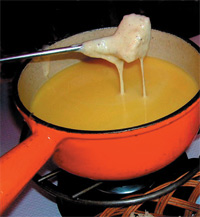 |
| Try washing up 50 of these |
I learnt a lot those 5 months that I have found useful at work ever since. The main lesson learned though is to watch out for triple whammies. As people add more tasks or projects to the mix they sometimes forget that gives them less time to do the same jobs they already have. Also, if volumes of transactions multiply at the same time they'll have even less time to do the second job and even less time to do the first job. Meltdown is always on the horizon.
So, in a growth company, my advice would be always to think about the proposed operational solution not only in the present, but in the future as well - and in a future where you are doing twice as much business.
Triple whammies happen all the time and when they do the only solution is to dig yourself out of a hole and fix the mess. By then you've probably caused some damage and you may have lost staff, customers or suppliers. That sucks.
You need to know how many cheese fondues is too many.
Thursday, 24 March 2011
Once upon a time in Soho
I was having lunch with a friend in a lovely vegetarian café in Soho this week and we were talking about work. He and I work in different companies, different jobs, but we share an interest in how the world works and a desire to learn.
He said, 'The bit I don’t get, is how to get my point across to the decision makers. I can blind them with logic, I can build a great presentation….'
He was struggling with what so many of us struggle with, influencing others. A few moments later we went back to the topic and I said, 'So, what other ways are there do you think to get a point across?' He started thinking out loud and after a few sentences he started getting warmer when he said, 'metaphor'.
I find that most people use a, rational approach, a deductive logical approach to solving problems and indentifying opportunities. Think it through, understand cause and effect, then put a solution together. The trouble is if you want others to adopt your solution, telling them so in a rational way doesn’t have the impact and influence.
How to get your point across?
I said to my friend, 'You could tell a story. Stories capture attention because we’ve been wired for tens of thousands of years to communicate using stories'. (For example, Jesus told parables, he didn’t state a moral code as such – he explained what people living that code did). I went on, 'it may be that you had a vivid conversation with a customer about your product and this validates the conclusion you came to using data and logic. If you tell the story first, then provide supporting data, you’ll have way more impact'.
(Of course – be sure to tell stories that support your rational conclusions, not the other way around. Anecdote is not data. Fool others, but don’t fool yourself – be sure the data supports the anecdote).
We continued our conversation and discussed the presentation methods and sales techniques that really work. Logic featured as back up, not a leading strategy. Other than stories, we identified using imagery, analogies and experiences.
It’s no co-incidence that I started writing this blog post as a story. I was hoping it would capture your attention better than it would if I just started out with explaining how to get a point across. Well did it?
Remember – we have two brains. A logical one and an emotional one. The emotional one always wins the battle for influence and the triggers you can use (stories, images, experience, patterns) are very different to the way in which you came up with the solution (logic, analysis, reasoning).
So, by all means solve a problem. To get others to act on your solution figure out how you can tell a story.
My friend and I will be meeting up in another month. Maybe I’ll bring you back another story.
Wednesday, 9 March 2011
If You Knew You Couldn't Fail, What Would You Do?
Have you ever seen a baby learning to walk? Of course you have. Now, tell me how they do it.
I'm lucky to have four kids. I didn't teach them to walk. They didn't teach each other. They just got up and had a go. First of all they started to figure out how to pull themselves up to stand against the furniture. Then they made one or two steps. A few weeks later and they were walking.
We all first learnt by trial and error.
Later in childhood, we start to learn from others. We are taught. We go to school. It's quite amazing to have my eldest daughter read a book to me. She's six. 6 months ago she couldn't read.
We are taught.
There's a third phase. Once we know how things work, we can go figure things out for ourselves. Some kids spend hours playing tennis, some spend hours programming, others spend hours and hours making things. Some of these kids will become the best in the world at what they do. Literally the best in the world. In this phase we practice. We seek guidance, we practice some more. We put hours and hours in. We make mistakes and learn from them. We practice some more.
We are self-taught and we practice.
But then - we become adults. Some people continue with trial and error (It's called 'learning on the job' in the business world. Some are taught (it's called 'training' in the business world). Some practice, work long hard hours, push themselves and become the best in the world at what they do. I'm not sure what we call these people, but I admire them.
I am more thirsty for knowledge now than I have ever been in my life. The more I learn the more I realise there is to learn. And I want to be the best in the world at what I do. Why? It's simple. There's very little in life that beats the feeling that you get when you say 'today I did what I do best!'
Today I will do what I do best. Will you?
Imagine a team where every person can say that. Can you imagine what that team would be able to achieve? It would be extraordinary. World beating. In fact just writing this makes my hairs stand on end - it really is something special. It's like watching the Oxford Cambridge Boat Race and seeing the winners win. It's awesome.
The thing about great teams is, 1 plus 1 equals 3. The sum of the parts is greater than the whole. Only it's not guaranteed. Sometimes two egotistical geniuses equal less than two because they haven't figured how to collaborate well.
So - on a practical note then, how do we build great teams where every person does what they do best and on top of that build a winning team?
How do we make that team possible?
Here, I think are the 5 main ingredients;
1. Allow people to make mistakes.
If we make more mistakes, we learn more. I'm not saying that we should aim to fail. Rather we should always be 'doing'. Doing something means you have the opportunity to learn. If you don't do anything you won't make any mistakes, but then again you won't learn anything. This is the thinking behind the phrase 'fail faster'. It's not that you should aim to fail - instead, you should 'do more faster' - because that's how you'll learn.
Fear holds us back though. We are afraid to make mistakes in case it's not seen as successful by our peers and egos.
My wife and I were talking the other day about why she is successful at what she does. She does business development for a recruitment firm and she needs to figure out how to book meetings with HR Managers and then persuade them to use her firm's services. She said that you can't book meetings without making phone calls, so she has to be very persistent to keep calling until she gets the meeting. She will keep calling way long after other people have given up. Most people fear the rejection, whereas she doesn't.
Her motto is "if you knew you wouldn't fail, what would you do?" Great advice indeed.
So - as a manager, I will always say to my team, 'make decisions and do stuff. Better to do lots and be right 95% of the time than to do a little and be right 100% of the time'. You'll learn faster and so will I.
2. Trust your colleagues and help them to learn from their mistakes
You can only truly build a successful team if there is true openness. I need to be open with my intentions, emotions and reasoning. By doing so, my colleagues can help me identify what I'm doing well and what I can do better and I will learn faster. If I do this though I am opening myself up. I am doing exactly the opposite of what most people do in business. It needs mutual trust, respect and willing - and it needs to start at the top.
3. Design learning structures
A great example of this is how we used to run our software development cycles in one of my previous companies. We planned our work in two week cycles. This was pretty effective in terms of getting things done. The important ingredient I think that actually made it successful was that after every cycle ('sprint') we set up a 'retrospective meeting'. This was a simple meeting where we simply asked, 'what went well, what didn't go so well and how will we in future do more of the good stuff and less of the bad stuff?' Doing this systematically requires a regular meeting slot in the diary, an agenda and a habit. It requires structure.
Good teams consciously create these structures to become learning teams.
4. Hire people that can handle this culture
This is critical. If you believe that you want to build world class winning teams you need to hire accordingly. Sure you need talent and experience. I say they're over-rated.
Just because someone has knowledge and ingredients to make a great cake it doesn't mean that they will. And just because someone was motivated to bake great cakes in the past doesn't mean that they will do so again in a different kitchen.
What really matters is
- does this person know how to apply themselves to a challenge?
- is this person willing to open themselves up and be fully transparent with their emotions, reasoning and intentions?
- are they able to give feedback to others in a helpful way?
- are they thirsty to be the best in the world at something?
5. Go with the flow
You cannot tell people what motivates them. In my experience, people do best what they are interested in, not necessarily what they are good at. I might be quite good at filing and organising paperwork, it doesn't mean I'm interested in it. Give me a reason to be interested in it or find me something to do that I am interested in and I will do it well. Really well.
So - as people develop in your team, find opportunities for them and help them where possible to grow in your organisation to do what they do best. Build the team around the capabilities you have and seek out new team members to fill the gaps if they exist (and make sure you follow the points in point 4).
To conclude
Great parent allow their children to make mistakes, they teach them all they can, and they give them wings to fly and pursue their own dreams.
In a team, we must think of ourselves as parents of each other.
And every day, if we strive to be the best we can be in what we do we'll need to push ourselves to the limit and make a few mistakes. It's the mistakes that lead us to truth.
Benjamin Franklin once wrote,
'Perhaps the history of the errors of mankind, all things considered, is more valuable and interesting than that of their discoveries. Truth is uniform and narrow; it does not seem to require so much an active energy, as a passive aptitude of soul in order to encounter it. But error is endlessly diversified'
Fail faster. Act like a child and a parent at the same time. Be the best in the world at something every day.
I'm lucky to have four kids. I didn't teach them to walk. They didn't teach each other. They just got up and had a go. First of all they started to figure out how to pull themselves up to stand against the furniture. Then they made one or two steps. A few weeks later and they were walking.
We all first learnt by trial and error.
Later in childhood, we start to learn from others. We are taught. We go to school. It's quite amazing to have my eldest daughter read a book to me. She's six. 6 months ago she couldn't read.
We are taught.
There's a third phase. Once we know how things work, we can go figure things out for ourselves. Some kids spend hours playing tennis, some spend hours programming, others spend hours and hours making things. Some of these kids will become the best in the world at what they do. Literally the best in the world. In this phase we practice. We seek guidance, we practice some more. We put hours and hours in. We make mistakes and learn from them. We practice some more.
We are self-taught and we practice.
But then - we become adults. Some people continue with trial and error (It's called 'learning on the job' in the business world. Some are taught (it's called 'training' in the business world). Some practice, work long hard hours, push themselves and become the best in the world at what they do. I'm not sure what we call these people, but I admire them.
I am more thirsty for knowledge now than I have ever been in my life. The more I learn the more I realise there is to learn. And I want to be the best in the world at what I do. Why? It's simple. There's very little in life that beats the feeling that you get when you say 'today I did what I do best!'
Today I will do what I do best. Will you?
Imagine a team where every person can say that. Can you imagine what that team would be able to achieve? It would be extraordinary. World beating. In fact just writing this makes my hairs stand on end - it really is something special. It's like watching the Oxford Cambridge Boat Race and seeing the winners win. It's awesome.
The thing about great teams is, 1 plus 1 equals 3. The sum of the parts is greater than the whole. Only it's not guaranteed. Sometimes two egotistical geniuses equal less than two because they haven't figured how to collaborate well.
So - on a practical note then, how do we build great teams where every person does what they do best and on top of that build a winning team?
How do we make that team possible?
Here, I think are the 5 main ingredients;
1. Allow people to make mistakes.
If we make more mistakes, we learn more. I'm not saying that we should aim to fail. Rather we should always be 'doing'. Doing something means you have the opportunity to learn. If you don't do anything you won't make any mistakes, but then again you won't learn anything. This is the thinking behind the phrase 'fail faster'. It's not that you should aim to fail - instead, you should 'do more faster' - because that's how you'll learn.
Fear holds us back though. We are afraid to make mistakes in case it's not seen as successful by our peers and egos.
My wife and I were talking the other day about why she is successful at what she does. She does business development for a recruitment firm and she needs to figure out how to book meetings with HR Managers and then persuade them to use her firm's services. She said that you can't book meetings without making phone calls, so she has to be very persistent to keep calling until she gets the meeting. She will keep calling way long after other people have given up. Most people fear the rejection, whereas she doesn't.
Her motto is "if you knew you wouldn't fail, what would you do?" Great advice indeed.
So - as a manager, I will always say to my team, 'make decisions and do stuff. Better to do lots and be right 95% of the time than to do a little and be right 100% of the time'. You'll learn faster and so will I.
2. Trust your colleagues and help them to learn from their mistakes
You can only truly build a successful team if there is true openness. I need to be open with my intentions, emotions and reasoning. By doing so, my colleagues can help me identify what I'm doing well and what I can do better and I will learn faster. If I do this though I am opening myself up. I am doing exactly the opposite of what most people do in business. It needs mutual trust, respect and willing - and it needs to start at the top.
3. Design learning structures
A great example of this is how we used to run our software development cycles in one of my previous companies. We planned our work in two week cycles. This was pretty effective in terms of getting things done. The important ingredient I think that actually made it successful was that after every cycle ('sprint') we set up a 'retrospective meeting'. This was a simple meeting where we simply asked, 'what went well, what didn't go so well and how will we in future do more of the good stuff and less of the bad stuff?' Doing this systematically requires a regular meeting slot in the diary, an agenda and a habit. It requires structure.
Good teams consciously create these structures to become learning teams.
4. Hire people that can handle this culture
This is critical. If you believe that you want to build world class winning teams you need to hire accordingly. Sure you need talent and experience. I say they're over-rated.
Just because someone has knowledge and ingredients to make a great cake it doesn't mean that they will. And just because someone was motivated to bake great cakes in the past doesn't mean that they will do so again in a different kitchen.
What really matters is
- does this person know how to apply themselves to a challenge?
- is this person willing to open themselves up and be fully transparent with their emotions, reasoning and intentions?
- are they able to give feedback to others in a helpful way?
- are they thirsty to be the best in the world at something?
5. Go with the flow
You cannot tell people what motivates them. In my experience, people do best what they are interested in, not necessarily what they are good at. I might be quite good at filing and organising paperwork, it doesn't mean I'm interested in it. Give me a reason to be interested in it or find me something to do that I am interested in and I will do it well. Really well.
So - as people develop in your team, find opportunities for them and help them where possible to grow in your organisation to do what they do best. Build the team around the capabilities you have and seek out new team members to fill the gaps if they exist (and make sure you follow the points in point 4).
To conclude
Great parent allow their children to make mistakes, they teach them all they can, and they give them wings to fly and pursue their own dreams.
In a team, we must think of ourselves as parents of each other.
And every day, if we strive to be the best we can be in what we do we'll need to push ourselves to the limit and make a few mistakes. It's the mistakes that lead us to truth.
Benjamin Franklin once wrote,
'Perhaps the history of the errors of mankind, all things considered, is more valuable and interesting than that of their discoveries. Truth is uniform and narrow; it does not seem to require so much an active energy, as a passive aptitude of soul in order to encounter it. But error is endlessly diversified'
Fail faster. Act like a child and a parent at the same time. Be the best in the world at something every day.
Thursday, 17 February 2011
Thermodynamics, evolution, wealth and happiness
If I was to say to you that there's a fundamental foundation that links life, physics, wealth, happiness and effort, would you;
a) yawn?
b) laugh?
c) sit up and listen?
If c, read on. Recent reading and thinking has led me to the following conclusion;
Firstly, that the first and second law of thermodynamics hold the keys to the meaning of life. And secondly, progress and wealth are underpinned by an evolutionary mechanism that is universal.
Come again?
I guess I'll need to explain in more detail. I'm not sure I can do it in a single blog post, so bear with me as I fire up a few synapses.
The first law of thermodynamics expresses that energy can be transformed, i.e. changed from one form to another, but cannot be created nor destroyed.
The second law of thermodynamics is an expression of the tendency that over time, differences in temperature, pressure, and chemical potential equilibrate in an isolated physical system.
i.e. - the universe has a finite amount of energy, the universe is an isolated physical system and energy will level out in this system.
The levelling out process is called entropy. In it's most general sense one can regard entropy as the general decay that surrounds us. A new car will eventually rust, a building will need new paint, food will rot, people grow old and stuff just generally falls apart. New life however is sustained by the sun which provides energy for living creatures.
Life requires continued energy to be sustained otherwise it fades and dies. To stay alive, we need to eat and sleep. (Doing nothing is not an option). There's a certain amount of energy required to stay where we are; we have to keep walking forward to stand still. Every day we need our 2 or 3 thousand calories of energy, we need to rejuvenate with our sleep.
If we do more than just stand still it requires effort. If you want to be wealthy, it requires effort. If you want to have a family and prolong your gene-pool, it requires effort. There's effort required to stand still and yet more effort to more forward.
The effect of all of this extra effort is a temporary suspension of entropy.
We strive against a tide of entropy that surrounds us and the efforts we all make on a daily basis help drive humanity forward. We have an inner drive and purpose to temporarily suspend entropy. This drive, this striving, is the essence of life. It gives us satisfaction, it gives us meaning and it gives us value. I would even go so far as to suggest that it is the source of our happiness.
When considering the business landscape, you could see it in this way: businesses competing to create business models that temporarily deliver additional value. Over time, new business models become the norm, become commoditised and so companies need to innovate (strive) to do more than stand still. Those that succeed create wealth, those that don't decay and die.
Behind both humanity and business is a common evolutionary algorithm. This evolutionary algorithm is a method to uncover (not by pre-determined means, but by trial and error), organism designs and business plan designs that are optimal for the environment in which they find themselves.
To make sense of life and to make sense of business, you could like me take the following view;
1. We are part of the fabric of life itself, iterations of the human species that are being continuously tweaked to be optimised for the environment we find ourselves in by an evolutionary method
2. We derive satisfaction (value) by striving to do more than to stand still and to suspend entropy as best we can
3. Businesses work by the same means, combining previous business knowledge into new business designs that can temporarily beat the competition (suspend entropy) and create value. To win they must continuously innovate and embrace evolutionary methods in their architecture.
The laws of thermodynamics, together with an evolutionary mechanic are foundational in understanding the human need to strive and the business need to innovate. One delivers satisfaction and happiness, the other value and wealth. Businesses are but collections of humans so this should be no surprise.
If you are still reading this and wonder what I'm on to deliver such a stream of consciousness, there's two things you should know. I once studied Theology and Religious Studies at University (but am currently an atheist) and that I've recently read "The Origin of Wealth" by Eric Beinhocker. If you get a chance do read Beinhocker, it will help develop the thinking that I've scraped the surface of here.
a) yawn?
b) laugh?
c) sit up and listen?
If c, read on. Recent reading and thinking has led me to the following conclusion;
Firstly, that the first and second law of thermodynamics hold the keys to the meaning of life. And secondly, progress and wealth are underpinned by an evolutionary mechanism that is universal.
Come again?
I guess I'll need to explain in more detail. I'm not sure I can do it in a single blog post, so bear with me as I fire up a few synapses.
The first law of thermodynamics expresses that energy can be transformed, i.e. changed from one form to another, but cannot be created nor destroyed.
The second law of thermodynamics is an expression of the tendency that over time, differences in temperature, pressure, and chemical potential equilibrate in an isolated physical system.
i.e. - the universe has a finite amount of energy, the universe is an isolated physical system and energy will level out in this system.
The levelling out process is called entropy. In it's most general sense one can regard entropy as the general decay that surrounds us. A new car will eventually rust, a building will need new paint, food will rot, people grow old and stuff just generally falls apart. New life however is sustained by the sun which provides energy for living creatures.
Life requires continued energy to be sustained otherwise it fades and dies. To stay alive, we need to eat and sleep. (Doing nothing is not an option). There's a certain amount of energy required to stay where we are; we have to keep walking forward to stand still. Every day we need our 2 or 3 thousand calories of energy, we need to rejuvenate with our sleep.
If we do more than just stand still it requires effort. If you want to be wealthy, it requires effort. If you want to have a family and prolong your gene-pool, it requires effort. There's effort required to stand still and yet more effort to more forward.
The effect of all of this extra effort is a temporary suspension of entropy.
We strive against a tide of entropy that surrounds us and the efforts we all make on a daily basis help drive humanity forward. We have an inner drive and purpose to temporarily suspend entropy. This drive, this striving, is the essence of life. It gives us satisfaction, it gives us meaning and it gives us value. I would even go so far as to suggest that it is the source of our happiness.
When considering the business landscape, you could see it in this way: businesses competing to create business models that temporarily deliver additional value. Over time, new business models become the norm, become commoditised and so companies need to innovate (strive) to do more than stand still. Those that succeed create wealth, those that don't decay and die.
Behind both humanity and business is a common evolutionary algorithm. This evolutionary algorithm is a method to uncover (not by pre-determined means, but by trial and error), organism designs and business plan designs that are optimal for the environment in which they find themselves.
To make sense of life and to make sense of business, you could like me take the following view;
1. We are part of the fabric of life itself, iterations of the human species that are being continuously tweaked to be optimised for the environment we find ourselves in by an evolutionary method
2. We derive satisfaction (value) by striving to do more than to stand still and to suspend entropy as best we can
3. Businesses work by the same means, combining previous business knowledge into new business designs that can temporarily beat the competition (suspend entropy) and create value. To win they must continuously innovate and embrace evolutionary methods in their architecture.
The laws of thermodynamics, together with an evolutionary mechanic are foundational in understanding the human need to strive and the business need to innovate. One delivers satisfaction and happiness, the other value and wealth. Businesses are but collections of humans so this should be no surprise.
If you are still reading this and wonder what I'm on to deliver such a stream of consciousness, there's two things you should know. I once studied Theology and Religious Studies at University (but am currently an atheist) and that I've recently read "The Origin of Wealth" by Eric Beinhocker. If you get a chance do read Beinhocker, it will help develop the thinking that I've scraped the surface of here.
Thursday, 10 February 2011
How not to ask for a phone number
A real life lesson in simple usability improvements that can improve conversion rates.
My wife and I love the movies, so to celebrate Valentine's Day this weekend we'll be going to our local cinema to see "The Kings Speech". I've heard it's very good.
I booked online with at the cineworld.co.uk site (@cineworld) and only just managed to book thanks to a rather horrible usability hurdle. Here follows what I wrote to them using the contact pages after the experience.
Dear Cineworld
"...I wanted to share with you a usability problem I had with the payment pages. If my experience is anything to go by it will be seriously hampering your conversion rates and if you fix it should improve your bottom line immediately...
It's to do with the validation of the mobile phone number.
I initially put in my number as follows;
077XXXXXXXX
The error message told me to add the country code. So I did;
+4477XXXXXXXX
The error message told me to only use digits. So I did;
004477XXXXXXXX
Then the was another error message. Can't remember exactly what it said. To get through the validation process I needed to actually type;
4477XXXXXXXX
4 attempts!
From someone who works building websites for a living and has done so for the last 11 years!
It's quite possibly the worst validation experience I've ever had.
Suggestions;
1. If you want to capture the data in that format tell them so in the form up front
2. Alternatively have a drop down of country codes to select from with UK as default. Then ask people to enter their number as normal in the field and get your programmers to remove the first zero and any spaces.
In essence - you're making it way too complicated.
Hope you find this useful..."
What's happened here?
I've seen this happen many times.
The developer says, "In order to send SMS confirmation messages, my system needs clean and correct numbers. I need the country code, then the mobile number in the following format; [XXYYYYYYYYYY] (where X is the country code, no zeroes, no symbols and Y is the number, no spaces, no zero up front)".
The developer does not say, "How do people usually type in their mobile numbers? How can I help them enter it in a way that is obvious for them and still helps me get the data in the format I need"
Don't blame the developer though. The producer / product manager should be on top of this during the design process and the interaction designer should instruct the developer.
Cineworld, to be fair have built a pretty intuitive website and it's very easy to find and select a movie to book.
Funnily enough, Cineworld did populate the form with a suggestion format in the field. I didn't see it, the light grey was so light it didn't register. Then, when I got it wrong, I didn't have obvious instructions on what the format should have been.

The only way top really test this is to watch real people using it. People with nothing to do with the design process. Learn from idiots like me, tweak the form, then measure the results. How many more visitors converted into bookings did I make as a result of that change? Sounds obvious.
Be your own customer.
My wife and I love the movies, so to celebrate Valentine's Day this weekend we'll be going to our local cinema to see "The Kings Speech". I've heard it's very good.
I booked online with at the cineworld.co.uk site (@cineworld) and only just managed to book thanks to a rather horrible usability hurdle. Here follows what I wrote to them using the contact pages after the experience.
Dear Cineworld
"...I wanted to share with you a usability problem I had with the payment pages. If my experience is anything to go by it will be seriously hampering your conversion rates and if you fix it should improve your bottom line immediately...
It's to do with the validation of the mobile phone number.
I initially put in my number as follows;
077XXXXXXXX
The error message told me to add the country code. So I did;
+4477XXXXXXXX
The error message told me to only use digits. So I did;
004477XXXXXXXX
Then the was another error message. Can't remember exactly what it said. To get through the validation process I needed to actually type;
4477XXXXXXXX
4 attempts!
From someone who works building websites for a living and has done so for the last 11 years!
It's quite possibly the worst validation experience I've ever had.
Suggestions;
1. If you want to capture the data in that format tell them so in the form up front
2. Alternatively have a drop down of country codes to select from with UK as default. Then ask people to enter their number as normal in the field and get your programmers to remove the first zero and any spaces.
In essence - you're making it way too complicated.
Hope you find this useful..."
What's happened here?
I've seen this happen many times.
The developer says, "In order to send SMS confirmation messages, my system needs clean and correct numbers. I need the country code, then the mobile number in the following format; [XXYYYYYYYYYY] (where X is the country code, no zeroes, no symbols and Y is the number, no spaces, no zero up front)".
The developer does not say, "How do people usually type in their mobile numbers? How can I help them enter it in a way that is obvious for them and still helps me get the data in the format I need"
Don't blame the developer though. The producer / product manager should be on top of this during the design process and the interaction designer should instruct the developer.
Cineworld, to be fair have built a pretty intuitive website and it's very easy to find and select a movie to book.
Funnily enough, Cineworld did populate the form with a suggestion format in the field. I didn't see it, the light grey was so light it didn't register. Then, when I got it wrong, I didn't have obvious instructions on what the format should have been.

The only way top really test this is to watch real people using it. People with nothing to do with the design process. Learn from idiots like me, tweak the form, then measure the results. How many more visitors converted into bookings did I make as a result of that change? Sounds obvious.
Be your own customer.
Saturday, 20 February 2010
Being Human, Implications For Organisations
Here’s where I’m currently at; it’s my belief that there are four key building blocks that form our perception of life:
Language
Emotion
Senses
Memory
I also reckon that if you view an organisation (or company) in the same way, it allows you to figure out how to influence its thinking and behaviour.
This is a tentative conclusion that I’ve reached after discussion and thought over the past few weeks. I’ve been thinking about what elements form the “essence” of our experience and understanding. It started when I realised that we as humans differ immensely from our animal friends in our use of language. Our brains articulate ideas and facts through language and our intentional communication, whether through speech, expression, or text, is rooted in a linguistic thought process. Language is intensely powerful in its ability to convey meaning but if used inconsistently can hide meaning. More about that later.
Then, realising that non-intentional communication (reactive expression for example) is more likely a result of emotion than language, I started to understand that there are some fundamental building blocks that allow the grey matter in our skulls to interact with its environment. There’s language, there’s emotion. Building blocks.
Another core building block (or a set of building blocks of course) are our five senses; sight, hearing, taste, smell and touch. These are inputs that guide us on our way.
For us to learn and to put into context our situation, we have memory. Memory, whether physical or mental, allows us to recognise patterns, store knowledge, build skills and interpret emotions.
These then are four core building blocks of being human: language, emotion, senses and memory.
Mastering these building blocks can lead to integrity, success and contentment.
Implications for organisations
As soon as you realise that these four building blocks exist, and that if they are developed and mature it can lead to integrity, success and contentment, you start to assess an organisation against the four areas.
Language
- Do we use inclusive language? I personally am on a mission to remove acronyms and abbreviations from my communication and where possible to remove it throughout the company. If you don’t know what an acronym means, you feel excluded, or just don’t understand.
- In meetings, does everyone understand the meaning of words? This is especially important in a multi-cultural company. I often pick up on complicated words and ask people to explain them for the benefit of the group. I know I understand the word, but I’m concerned that others might not.
- Do we all have the same vocabulary? What we call things carries immense power. Words convey meaning; therefore what you call something (e.g. “team member”, colleague”, “employee”, staff member”, “worker”) determines many things, not least of all how it affects company culture. Personally I detest the use of the word “department” because it conveys compartmentalisation, and I want to build a company culture of teamwork where the best people work together to get the job done. Naming of products, processes, procedures, office areas, events and job titles all matters. Far more than you can ever imagine. Change the language, change the culture.
Emotions
- Knowing whether we are slaves to our emotions or whether we are acting rationally is an important skill as a human being. Knowing when to listen to your emotions is important in life, and therefore this is also the case within companies. Ego, pride, fear, greediness – these for example are all emotions that a company can evoke in the way it reacts to its environment. Sometimes these are useful, sometimes not, but a company needs to be self-aware to understand if it’s acting emotionally and if so, why this is so?
Senses
- Of course, if we are to make business decisions, it’s good to have accurate information about your environment: your customers, your investors, your team, and your competitors. To gain this information, you need to look and listen, and sometimes, taste, touch or smell (particularly useful in the case of a restaurant business for example). Companies that fail to hone their senses, fail their potential.
Memory
- Winston Churchill said, “Success is going from failure to failure without losing enthusiasm”. By experiencing life we start to understand what works and what doesn’t. Trial and error has always been a certain way to learn. In this context, it’s our memory that serves us, that helps us recognise patterns and to build up intuition.
- As a Firefighter, Chef or CEO, every successful individual has along the way learnt from their mistakes. As a company therefore, how do you help yourself become a learning organisation?
- For a start, recognise mistakes, admit failure. Discuss what could go better next time.
- Also, create methods to store knowledge. People come and go. Whether in the form of documentation or training others, without making an effort to store skills and knowledge, they’ll leak, they’ll fade and you’ll have to re-learn.
If you want in business to create a happy and successful company built with integrity, pay attention to the four building blocks of human experience: language, emotion, memory and senses.
Language
Emotion
Senses
Memory
I also reckon that if you view an organisation (or company) in the same way, it allows you to figure out how to influence its thinking and behaviour.
This is a tentative conclusion that I’ve reached after discussion and thought over the past few weeks. I’ve been thinking about what elements form the “essence” of our experience and understanding. It started when I realised that we as humans differ immensely from our animal friends in our use of language. Our brains articulate ideas and facts through language and our intentional communication, whether through speech, expression, or text, is rooted in a linguistic thought process. Language is intensely powerful in its ability to convey meaning but if used inconsistently can hide meaning. More about that later.
Then, realising that non-intentional communication (reactive expression for example) is more likely a result of emotion than language, I started to understand that there are some fundamental building blocks that allow the grey matter in our skulls to interact with its environment. There’s language, there’s emotion. Building blocks.
Another core building block (or a set of building blocks of course) are our five senses; sight, hearing, taste, smell and touch. These are inputs that guide us on our way.
For us to learn and to put into context our situation, we have memory. Memory, whether physical or mental, allows us to recognise patterns, store knowledge, build skills and interpret emotions.
These then are four core building blocks of being human: language, emotion, senses and memory.
Mastering these building blocks can lead to integrity, success and contentment.
Implications for organisations
As soon as you realise that these four building blocks exist, and that if they are developed and mature it can lead to integrity, success and contentment, you start to assess an organisation against the four areas.
Language
- Do we use inclusive language? I personally am on a mission to remove acronyms and abbreviations from my communication and where possible to remove it throughout the company. If you don’t know what an acronym means, you feel excluded, or just don’t understand.
- In meetings, does everyone understand the meaning of words? This is especially important in a multi-cultural company. I often pick up on complicated words and ask people to explain them for the benefit of the group. I know I understand the word, but I’m concerned that others might not.
- Do we all have the same vocabulary? What we call things carries immense power. Words convey meaning; therefore what you call something (e.g. “team member”, colleague”, “employee”, staff member”, “worker”) determines many things, not least of all how it affects company culture. Personally I detest the use of the word “department” because it conveys compartmentalisation, and I want to build a company culture of teamwork where the best people work together to get the job done. Naming of products, processes, procedures, office areas, events and job titles all matters. Far more than you can ever imagine. Change the language, change the culture.
Emotions
- Knowing whether we are slaves to our emotions or whether we are acting rationally is an important skill as a human being. Knowing when to listen to your emotions is important in life, and therefore this is also the case within companies. Ego, pride, fear, greediness – these for example are all emotions that a company can evoke in the way it reacts to its environment. Sometimes these are useful, sometimes not, but a company needs to be self-aware to understand if it’s acting emotionally and if so, why this is so?
Senses
- Of course, if we are to make business decisions, it’s good to have accurate information about your environment: your customers, your investors, your team, and your competitors. To gain this information, you need to look and listen, and sometimes, taste, touch or smell (particularly useful in the case of a restaurant business for example). Companies that fail to hone their senses, fail their potential.
Memory
- Winston Churchill said, “Success is going from failure to failure without losing enthusiasm”. By experiencing life we start to understand what works and what doesn’t. Trial and error has always been a certain way to learn. In this context, it’s our memory that serves us, that helps us recognise patterns and to build up intuition.
- As a Firefighter, Chef or CEO, every successful individual has along the way learnt from their mistakes. As a company therefore, how do you help yourself become a learning organisation?
- For a start, recognise mistakes, admit failure. Discuss what could go better next time.
- Also, create methods to store knowledge. People come and go. Whether in the form of documentation or training others, without making an effort to store skills and knowledge, they’ll leak, they’ll fade and you’ll have to re-learn.
If you want in business to create a happy and successful company built with integrity, pay attention to the four building blocks of human experience: language, emotion, memory and senses.
Wednesday, 23 September 2009
Learn Something New Every Day
You learn something new every day, so goes the saying.
We all have different things that make us "tick". For me, one of the strongest motivators is learning something new, either through experience or through reading.
Here's a little snippet I picked up yesterday. I was reading Peter Hargreave's book "In For A Penny", the story of how he and his business partner built up their business from scratch starting with just a telephone and a desk in a spare bedroom. Now the business (Hargeaves Lansdown) is one of the biggest financial services firms in the UK and is a listed public company.
Aside from picking up on their business principles (best service, best prices, best information), their company culture (put the customer first, the company second, yourself third), and their innovative real time trading platform for private investors, one little snippet of trivia grabbed my attention.
When you come to cash in your pension on retirement, one option is to buy an annuity with your pension fund (I knew that already by the way). This annuity is a fixed regular payment that you receive for the rest of your life. The life companies that sell these policies assess your risk profile. High risk, you can buy less income with your money, low risk, you can buy more.
The interesting thing is that the more money you have in your pension, the more risky you are to a life company. Why? Well it seems statistically that people with more money live longer. Maybe this is because they can afford a better lifestyle and health care, I'm not sure. As they live longer, then the life company has to pay out the fixed sum for longer, so therefore large pension fund owners will find it more difficult to get a better deal.
I thought about this for a moment on the train. First of all, I was disappointed that if I did make the effort to save harder, I would get a worse deal. However the upside is much more interesting; work hard to accumulate a bigger pot and you might live longer. I'd never thought of life expectancy as a reason to work hard, but there it is.
But how to be successful? One of the other books I read recently was Malcolm Gladwell's book "Outliers". Here he looks at the truly successful people in their fields and looked at what patterns stood out.
It seems that you need "enough" education (not necessarily the best), "enough" talent (pure talent will not cut it on it's own), fortunate circumstances (luck), and the most important two ingredients of all: focus and effort.
This was encouraging. I'm a great believer in making your own luck. Work hard, see obstacles as opportunities and take control of your own destiny. Sure, life throws you a deck of cards, but even with an average hand you can play a good game.
Learning is great, and knowledge is best enjoyed if shared. Therefore at work recently I took the initiative to start a library. The two books I mentioned above plus another twenty or thirty from my personal bookshelves start the library stock. I've asked colleagues to also bring in their books to loan to the collection. I've bought library cards to put in the front of each book and developed a system for withdrawals and returns. I hope it takes off. I'm looking forward to sharing ideas and seeing the team grow through learning.
Learn something new every day. My new mantra.
We all have different things that make us "tick". For me, one of the strongest motivators is learning something new, either through experience or through reading.
Here's a little snippet I picked up yesterday. I was reading Peter Hargreave's book "In For A Penny", the story of how he and his business partner built up their business from scratch starting with just a telephone and a desk in a spare bedroom. Now the business (Hargeaves Lansdown) is one of the biggest financial services firms in the UK and is a listed public company.
Aside from picking up on their business principles (best service, best prices, best information), their company culture (put the customer first, the company second, yourself third), and their innovative real time trading platform for private investors, one little snippet of trivia grabbed my attention.
When you come to cash in your pension on retirement, one option is to buy an annuity with your pension fund (I knew that already by the way). This annuity is a fixed regular payment that you receive for the rest of your life. The life companies that sell these policies assess your risk profile. High risk, you can buy less income with your money, low risk, you can buy more.
The interesting thing is that the more money you have in your pension, the more risky you are to a life company. Why? Well it seems statistically that people with more money live longer. Maybe this is because they can afford a better lifestyle and health care, I'm not sure. As they live longer, then the life company has to pay out the fixed sum for longer, so therefore large pension fund owners will find it more difficult to get a better deal.
I thought about this for a moment on the train. First of all, I was disappointed that if I did make the effort to save harder, I would get a worse deal. However the upside is much more interesting; work hard to accumulate a bigger pot and you might live longer. I'd never thought of life expectancy as a reason to work hard, but there it is.
But how to be successful? One of the other books I read recently was Malcolm Gladwell's book "Outliers". Here he looks at the truly successful people in their fields and looked at what patterns stood out.
It seems that you need "enough" education (not necessarily the best), "enough" talent (pure talent will not cut it on it's own), fortunate circumstances (luck), and the most important two ingredients of all: focus and effort.
This was encouraging. I'm a great believer in making your own luck. Work hard, see obstacles as opportunities and take control of your own destiny. Sure, life throws you a deck of cards, but even with an average hand you can play a good game.
Learning is great, and knowledge is best enjoyed if shared. Therefore at work recently I took the initiative to start a library. The two books I mentioned above plus another twenty or thirty from my personal bookshelves start the library stock. I've asked colleagues to also bring in their books to loan to the collection. I've bought library cards to put in the front of each book and developed a system for withdrawals and returns. I hope it takes off. I'm looking forward to sharing ideas and seeing the team grow through learning.
Learn something new every day. My new mantra.
Subscribe to:
Posts (Atom)